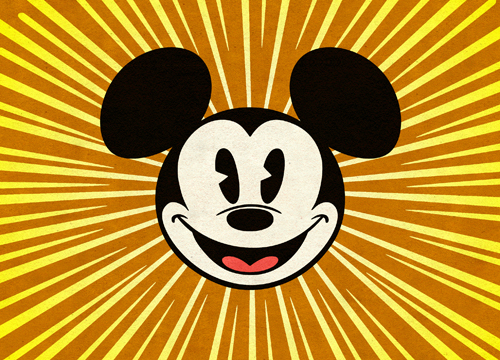
Mickey Mouse is an cartoon character co-created in 1928 by Walt Disney and Ub Iwerks.













The time travel adventure Steins;Gate began as an Xbox game, which was adapted to a light novel, a manga, a radio play and a board game before it became a popular broadcast series in 2011. Two years later, two of the directors and much of the staff returned to make the theatrical feature Steins;Gate: The Movie: Load Region of Déjà Vu.
In the series, college student and self-proclaimed “mad scientist” Rintaro Okabe (J. Michael Tatum) set up his Future Gadget Lab in a shabby apartment over an electronics repair shop in the Akihabara section of Tokyo. He assembled a group of misfits to assist his experiments: cheerful Cosplayer Mayuri Shiina (Jackie Ross), American-educated genius Kurisu Makisa (Trina Nishimura), über-hacker/nerd Itaru “Daru” Hashida (Tyson Rinehart), techno-warrior Suzuha Amane (Cherami Leigh), transgendered Ruka Urushibara (Lindsay Seidel) and shy texter Moeka Kiryu (Jessica Cavanagh).

This outré band managed to build a working time machine out of a decrepit microwave, a cel phone and other bits and bobs of electrical junk. Lab members could send texts that were received days before they were sent. Some of these messages changed the past in ways that altered the present: The Butterfly Effect. (In chaos theory, a small perturbation in the initial state of a system can cause dramatic changes in later conditions: The classic example is a butterfly flapping its wings in Brazil affects the next day’s weather in Beijing.) But only Okabe can remember how things were previously.
Okabe’s experiments attracted the wrath of the corrupt researchers at SERN (a variation of CERN, the scientific body that operates the Large Hadron Collider in Switzerland), who caused the deaths of two of his friends. He spent most of the second half of the series desperately remaking the “world lines”—altering the past to produce a future where Mayuri and Kurisu weren’t killed. After many traumatic failures, Okabe succeeded in creating the Steins;Gate, a version of the world where everyone was safe.
The film opens a year later, when Kurisu returns to Akihabara after a year of research and study in America. Initially, everyone seems fine. But the Steins;Gate continuity is inherently unstable. Okabe is haunted by flashbacks of other, darker realities. He begins to flicker in and out of existence. When he disappears, only Kurisu has more than a vague, uncertain memory of him.

Working with Suzuha, Kurisu is appalled to discover the lonely suffering Okabe has endured, sustaining the world that nurtures his friends. Armed with the knowledge that memory and emotion can transcend dimensional limits, Kurisu sets out to change the past one last time, to create a version of the present that can support everyone’s existence.
The Steins;Gate TV show was essentially Okabe’s story. The series was intriguing and funny, marred only by moments in which the self-consciously eccentric Okabe became obnoxious. The film is warmer and more serious, with less farcical humor. Directors Hiroshi Hamasaki and Takuya Sato and their crew shift the focus to Kurisu. Voice actress Trina Nishimura gives a winning, believable performance as a brilliant woman who shifts from fearful to threatened to remorseful to daring to loving without becoming passive, whiny or spunky. Few recent American features can boast a heroine as complex and compelling. The rest of the cast deftly pick up their familiar roles where they left off.
Taken together, the Steins;Gate series and feature form an endearingly offbeat sci-fi continuity that wins the audience’s loyalty without the eye candy of big-budget special effects. It’s a welcome reminder that characters are more memorable than explosions.
Steins;Gate: The Movie: Load Region of Déjà Vu
Funimation: $26.24 2 discs, DVD and Blu-ray