Mickey Mouse is an cartoon character co-created in 1928 by Walt Disney and Ub Iwerks.










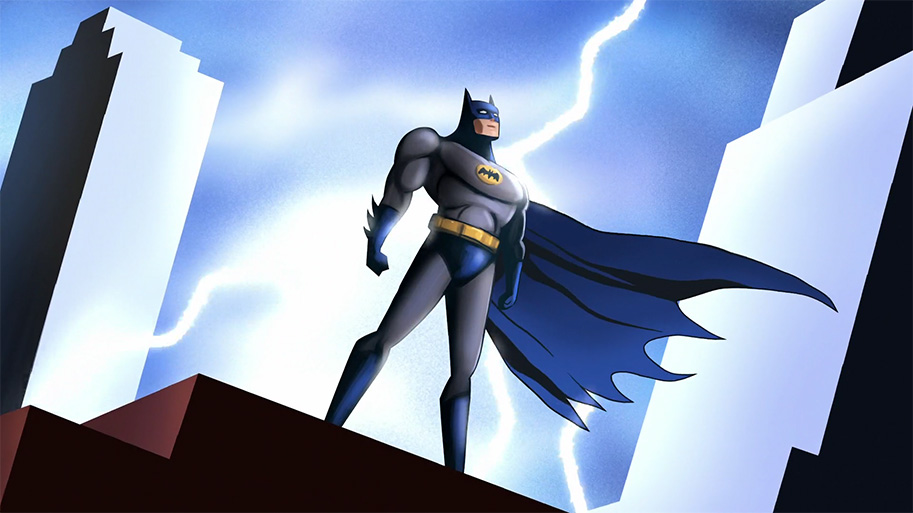
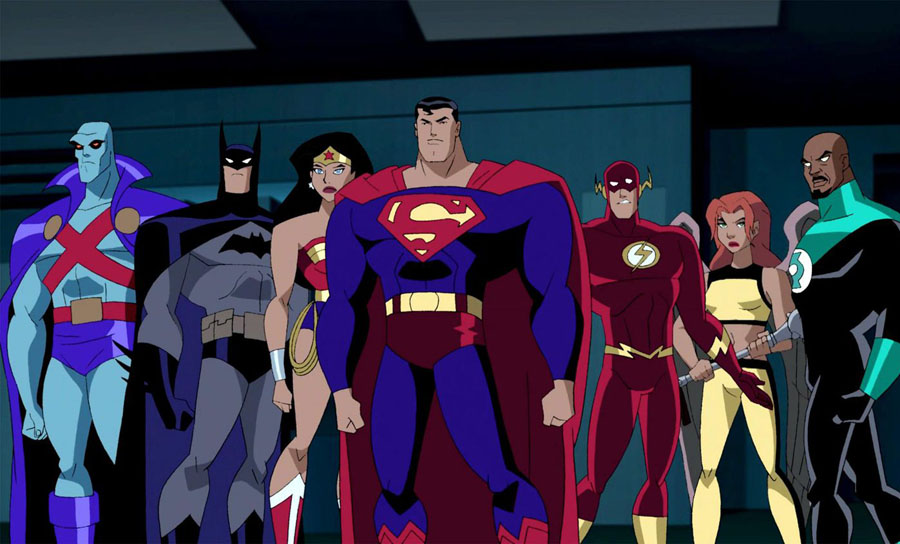
It’s amazing. As of 2026, it’s been nearly 34 years since the premieres of Batman: The Animated Series, 30 years since Superman: The Animated Series, 27-and-a-half years since Batman Beyond and 22 years since Justice League Unlimited. Yet even with this passage of time, interest in the DC Animated Universe remains high. One reason is the timeless quality of the shows, as provided by creative talents like Bruce Timm, Eric Radomski, Alan Burnett, Paul Dini, Andrea Romano, Kevin Conroy, Mark Hamill, Kevin Altieri, Dan Riba, Shirley Walker and a host of others. But a major reason is James Fletcher, who, through his Heroic Fine Art Gallery at conventions, provides an opportunity to buy DCAU artwork and meet the creators of the DCAU themselves. In effect, he’s preserving the legacy of the DCAU for the benefit of all the fans.
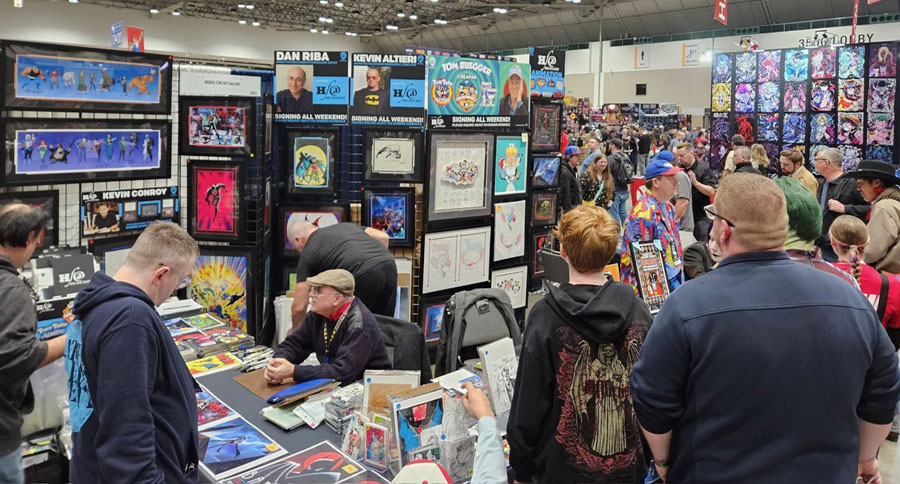
This weekend, June 26-28, Fletcher’s Heroic Fine Art Gallery is hosting ten DCAU talents at Fan Expo Anaheim, with the convention itself presenting Mark Hamill and Paul Williams live on stage with writer/producer Paul Dini. On June 23, I spoke with Fletcher about his contributions to animation history.
Bob Miller: James, please tell us about yourself.
James Fletcher: I’m a comic art fan. I’m an animation fan. But I was an art student. I studied art in college. But when I got out of college, instead of being a struggling artist or becoming a teacher, I decided to get into selling artwork. Even before college, I was doing little comic conventions, selling comic books, vintage comic books and things. Yeah, but gravitated toward the art very quickly, like signed and numbered limited edition pieces and then animation art, animation cels and production drawings, particularly the DC stuff. I’m definitely a DC fan. So that was kind of my entry into this whole world.
BM: When did you start doing this business?
JF: If I remember correctly, in 2001. The Warner Bros. Studio stores were in malls all over the country. Those all were eradicated when there was an AOL-Time Warner merger back then, and it got rid of all the retail stores. I was finishing college around that time and I thought, what is happening with all that merchandise and things from those retail outlets, and how do I get my hands on it? And what’s going to happen with the licensing and everything else? ‘Cause those stores were producing licensed, signed and numbered prints and statues and all manner of merchandise that you can think of, but they were also selling framed animation cels from Batman: The Animated Series and Batman Beyond and Superman at the time.
I was actually buying artwork between 1997 and 2000, probably, just from those stores. And eBay was brand new then, so you were able to buy things and flip things on eBay even in its infancy and make a profit. So that was my introduction to retailing and merchandising comic book and animation-related fine art.
BM: Okay, now was this a local business, or were you going online with your sales at this point?
JF: It was a little complicated, but it was a little bit of both. I grew up in California. So I started my little gallery in Sacramento. I had two different physical locations, but not fully mine. Kind of cooperative efforts, one with a frame shop that I did a lot of framing with and then another, a very famous comic book shop, seemed to be a good place to display some of my inventory on a consignment basis. So I was doing that. But yes, then predominantly it was online. It was via eBay. And then that’s when I created the first versions of my website.
BM: So you were filling a vacuum that was left behind by Warner Bros. with the retailing, correct?
JF: That’s exactly right. And I talk to old-time collectors about that where a lot of them still lament that all those stores closed. And I said I do as well, but at the same time, that opened the door for me and galleries like me to be able to get into this market and become officially sanctioned and authorized galleries of Warner Bros. animation product and other Warner Bros. .licensed prints.
BM: And you had to maintain approval from Warners to do your retailing?
JF: You really did. There were some hoops to jump through, some contracts to sign. It was a program run by Clampett Studio Collections, which actually was run for many years by Ruth Clampett, who is the daughter of famous animator Bob Clampett, who created Daffy Duck and Porky Pig. He created his own characters, Beany and Cecil and all that. So his daughter was actually working for Warner Bros., but when those stores closed, she was one of the people that said–similar to what my thoughts, but at a higher level, I guess–she’s like, “What’s happening with all this inventory?” She became like the de facto connection to the Warner Bros. stores because she had helped design some of the product that was sold in those stores. She bought all this inventory and then would wholesale it to galleries like me.
We had to sign contracts, and technically we were supposed to have a brick-and-mortar location. It was very old-school. Everyone was suspicious of this new internet and eBay and all those things, and they didn’t like it. They accepted the fact that I had cooperative physical brick-and-mortar locations, like with my framer and this comic book shop that I worked with. I pulled every string that I could. I usually don’t take no for an answer, so I was able to get into this program and become officially sanctioned. This is 25, 26 years ago.
BM: Aside from making a profit, would you describe the purpose of your business as a mission, an outreach to fans?
JF: Mission is a couple-fold. I mean, certainly profit factors in there, but I think if you really love the artwork and the genres that we’re talking about, the profit is tertiary. It was really about the relationship aspects of running such a business. And there are multiple levels of relationships, relationships with clients, fellow collectors, relationships with professional, legendary comic book artists and animators. That was very important. Certainly education is a mission. Definitely educating the buying public on what we were selling. Not everybody knows about animation cels, what they are, their collectability, why they’re expensive, things like that. And also those new comic art-related prints that were being published, particularly the art of Alex Ross, wonderful painter. His stuff blew me away, even his earliest work.
Giclée printing was brand new at the time. Giclée is a French term, and it roughly translates to “spray of paint,” which describes the printing process. You place a piece of canvas or fine art watercolor paper on basically a conveyor belt, and it would spray these pigments on. But they were so accurate, the most accurate reproductions at the time. That process is still used, and the digital process has kind of taken over the whole market. There’s not a lot of printing even that goes on anymore, like the old four-color separation type printing and lithography and everything else. It’s almost all digital now. But back then it was new, so you had these really beautifully accurate, high-end prints. Giclée prints on canvas, giclée prints on watercolor paper were all the rage. Especially with a beautiful painter like Alex Ross; his work looked very good in both formats. That was really the foundation of what I was doing. I was selling a lot of Alex Ross reproductions.
Like anything else, as time went on, printing got a little bit cheaper. But some people like Alex Ross still command high dollars in that type of market. It was an interesting time to be almost at the vanguard of it. It started at the Warner Bros. Studio Stores, but we were trying to continue that and trying to educate people about it.
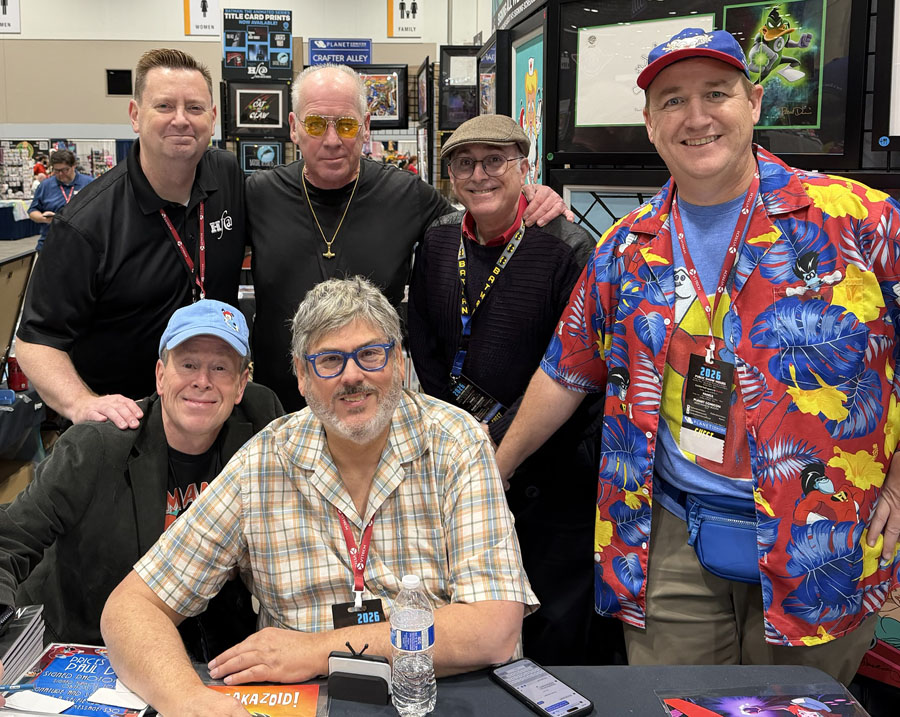
BM: Would you also say as part of your mission you’re actually preserving animation history?
JF: Well, that’s definitely the case, right? Because if someone isn’t actively doing such a thing, information can get lost. You know that very well. You’ve done your own part in preserving such a history by writing your encyclopedic tomes about a lot of the DCAU. But yeah, certainly that is a part of it. And so over the years, as I’ve been more actively doing conventions all over the country with the talent associated with Batman: The Animated Series and other series that came after, that’s definitely been a direct way to preserve that legacy? And actually introduce or reintroduce that legacy to subsequent generations and fans.
BM: What inspired you about Batman: The Animated Series and its spin-offs?
JF: A couple of things. I think initially it was certainly the look of the show, the artistic values that they were trying to present and accomplish, the things they were trying to do with animation. The writing was very good generally. One I can think of in particular, like “The Demon’s Quest,” the Ra’s al Ghul episodes where that’s a Denny O’Neil and Neal Adams story. They had to do it in a two-parter, but they did it really, really well, and it’s animated well. And I thought, I mean, I’m a college student at the time when these were coming out, but I thought they’re doing something really special. To see stories that I read as a young boy translated into that format was amazing. And then there were some episodes that stood out artistically, and you came to find out later that was because a Japanese animation house like TMS oversaw that. Like TMS doing, say, “On Leather Wings” and even “Feat of Clay, Part II.” Incredible, beautifully-drawn episodes, and both happen to be directed by Kevin Altieri, in fact.
That was something I would pay attention to too. Oh, who directed this? Who wrote this? But which animation houses were creating the animation made a huge difference. Some other early Kevin Altieri episodes like “The Last Laugh” or “Eternal Youth” were awesome stories, but the animation was nowhere near what something like “On Leather Wings” or “Feat of Clay, Part II.” So yeah, I was just obviously I was a fan like anybody else, but I was connected enough to it with comic book, knowing comic book history and what they were doing and what they were adapting, that I thought, “Oh man.” And even in studying art in school, I thought, “Oh, could I work? Could I work in animation and work on that?” Like, wouldn’t that be the most amazing dream job? It’s like somebody drawing all their life and getting the job they want in comic books, right? That was kind of an idea at the time, but at some point I realized I just wasn’t very good and that wasn’t gonna happen. But I wanted to be associated with it somehow, and I think through the retail aspect of it, I was able to be incredibly close to the whole animation process and the creators that worked on these series and things like that.
BM: It’s my impression that you actually specialize in selling Batman: The Animated Series artwork, DCAU artwork. Is that right?
JF: I do. But that’s been a more recent phenomenon. I’ve always sold it, going all the way back to the beginning. But honestly, a lot of the time when I was buying stuff from Warner Bros. studio stores or from Clampett, a lot of it I was buying it because I wanted it. I was collecting it. I certainly serviced other collectors that were also collecting such things. But that’s how it began. Again, I’m a fan at the foundation of all this. But yes, I sold that type of artwork, but it’s maybe right before COVID hit, where I’ve had an inordinate amount of fixation and focus on this stuff because I’ve been selling this artwork for 25 to 30 years and the supply is finite. And we’ve diminished it over the years. We’ve diminished it at a faster pace even since COVID because I’ve been really actively involved in helping organize that inventory and seeing what’s left. It’s amazing what’s still there in the Warner Bros. archives, and it’s sad to see certain episodes and sequences that are completely depleted. You cannot purchase cels from certain things anymore. They’re gone. They’re either in private collections or whatever.
Once you got into Batman Beyond, you couldn’t even buy artwork from a lot of these series except for the production drawings, the pencil drawings, because everything had gone digital. Animation cels were no longer used in the production. In very few instances could you even get pencil drawings for some of the later stuff once you got past the year 2000.
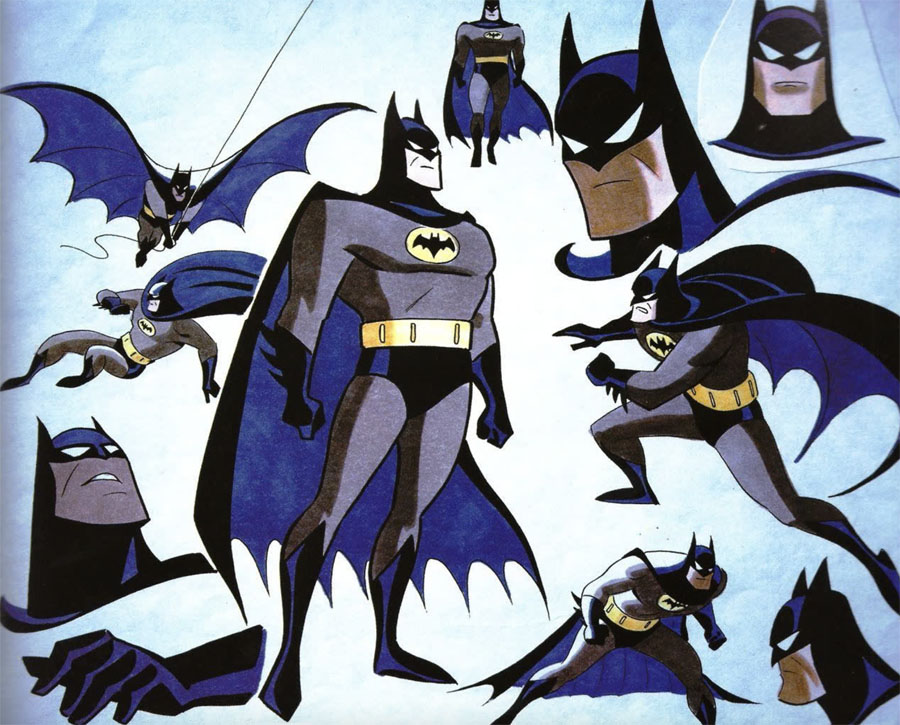
BM: When did you start signing up Batman: The Animated Series talent as your guests to your booths at conventions?
JF: The very first guest I ever had at a booth that worked on the series was Bruce Timm, at San Diego Comic-Con in 2005. Back then it was a different time. When you had guests at your booth, it was not as clear-cut as to how to monetize that. Most people didn’t charge for their signatures back then. He already had an original art agent, so I wasn’t really selling his originals for him and taking a commission or anything. He was just a guest appearance at my booth for a short time during the day, maybe a two-hour block or whatever. And a lot of times how we utilized that time was he signed things for my gallery if people happened to walk by or whatever. This is pre-social media. So, he might sign autographs for people. I had many people like that at my booth over those years, comic book legends like Neal Adams, Carmine Infantino, Jerry Robinson, but then even more modern artists like Adam Hughes and people like that that would be guests at my booth. But I kind of got away from it then for years after that because it was really fun and it was cool to hang out with them, but we weren’t smart enough to figure out how to make it work financially and make it worth everyone’s time.
The current iteration has been post-COVID. As creators and voice actors, et cetera, were charging for their autographs, it made more sense on how to monetize that right off the bat, but then we’d try to have more product that related to the guest that we had so that we could also sell that product and obviously the fan could get it signed as well in the same transaction.
So I called Alan Burnett or emailed him out of the blue. And we’d had several interactions over the years, but bless his heart, he was so kind to me. He said that he remembered me, and I don’t know if that’s true, but I said, “Hey,” and I sent him some pictures we had taken together a few years prior and all that.
I said, “Hey, this is what I do. Why don’t we have you come out to a show?” And I want to say it was Denver, Fan Expo Denver.
And I said, “We’ll feature you at the booth.” And we kept it very simple, but he was willing to do it. And that really started the avalanche of it. He and Brad Rader, a storyboard artist for Batman: The Animated Series, among other things, were the first guests that I had at my booth in many, many years. And we presented them both in Denver to good effect. And that was kind of like the litmus test. We did it and I thought, “Oh, I see everything now. I see how we can make it worth these guys’ time, how we can educate people on who these people are and what they did and how important they are.” And some people are such fans that they would already know and would seek these guys out anyway. And in the social media age, you could actually very easily promote such a thing, right? “Hey, I’m gonna be at booth number whatever at this event on these dates. Come see Alan Burnett, come see Brad Rader, come see Kevin Altieri, Dan Riba,” whoever it is.
That was the start of it. It could have been as early as 2021, in the summer when we did that event. The rest is history. So I can thank/blame Alan Burnett for giving me a shot. And we took good enough care of him that, bless his heart. These guys are all close, like they all know each other well. So if I screwed something up or if I treated anybody wrong, they would all know. But what it’s become is that, luckily, thank goodness, because these guys are so great to me, my reputation precedes itself. So I’ve grown the number of people relatively rapidly on who I “represent” or work with on a part-time basis to present them at conventions all over the country.
BM: Okay, so do you do this through their agents, I suppose?
JF: No, technically I’m their agent. That’s what it’s become. None of them really had agents of any sort. A lot of them, like Alan was retired already. So I think initially his interest in doing the shows, you could ask him, but he would probably say, “Well, you know, hey, I just wanted to get away for a weekend, have a good time and see a city that I haven’t seen and just sign some autographs for some fans.” Don’t get me wrong, he doesn’t do it for the money. I think he’s more doing it for the experience and for, again, experiencing a different city and taking a weekend vacation, maybe feeling some love from the fans, heaven forbid hanging out with me, with us or whatever. But he doesn’t do it for the money, is the point. So he’s actually one that I don’t do as many shows with him. He’s a lot more selective. Let’s say with Alan, I might only do two or three a year, maybe four if I twist his arm. So that depends. But as the reputation got around, like working with Brad, Brad would recommend Kevin Altieri. And then both Kevin and Brad recommended Dan Riba. And Dan Riba was still working in animation at the time, but once he wasn’t getting any more work, he says, “Hey, I have time to do shows now.” So I became their agent, essentially.
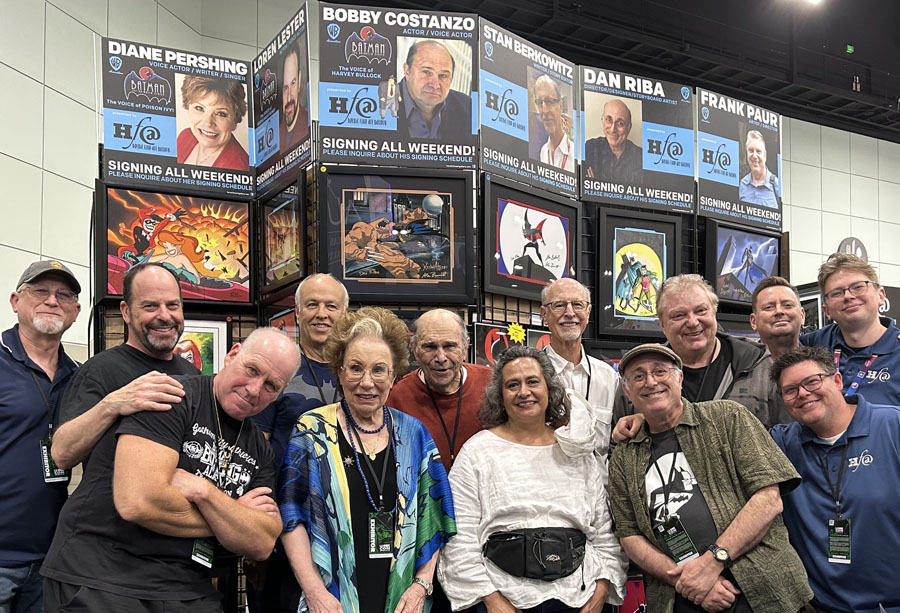
BM: Well, now it’s kind of snowballed with your guests that this upcoming convention, Fan Expo Anaheim. This is the most guests you’ve ever had, right?
JF: It is. It’s just a silly thing that I would do where, yeah, the snowball goes down the hill and then it becomes almost completely unmanageable. Last year at LA Comic Con, we had nine. We had four voice actors and then five of the artists, writers, producers that worked on the show. And it worked okay. I think it was manageable.
This opportunity was strange because this show came about very quickly. They didn’t announce it even until March of this year, and they needed to fill some spaces. But with Mark Hamill being the headliner basically of the show, they thought, well, we could have a Batman focus. And nine of the ten guests that we’re hosting for Fan Expo Anaheim are local. Right? They’re all Southern California guys. The only exception is Alan Burnett, who’s retired and was out in Florida. But we arranged to fly him in to be with all the guys. So it was kind of easy to put together in some respects, logistically, for that reason, that so many of them, nearly all of them, were local. But it provided a Batman focus that I think I’ve been trying to educate some of the larger shows, like Fan Expo like that, to see that these guys carry much more star power than they’re even credited for. People come to the shows knowing their work, knowing what they directed, knowing what they storyboarded, knowing what they produced, knowing what they wrote. So that’s the whole game right now, is to try to get the respect these guys deserve and to get them out there in front of the public and have the shows, the larger corporate shows, care.
So we have an opportunity to do that here in Anaheim, biggest one so far. John Calmette, renowned background painter and painted some of the most legendary images associated with the show, like the promo image with Batman pulling his cape over his face with the red moon behind him that’s used as the outro for every episode. He’s never done a show, ever. And Eric Radomski has never done a show. I’m sure he’s popped into San Diego over the years and would do some panels and things like that, but he’s never presented himself in such a way where you could buy things from him at a convention. So that’s kind of a cool thing that we arranged as part of this, too, to have Eric Radomski and John Calmette added to the pantheon here that we’re creating where they’ve never done such an event. So that’s fun and hopefully it’s worth their time. You never know with these first-year shows. But no matter what happens, we’re gonna have a good time and we’re gonna make as big a deal out of it as we can.
BM: Well, now what celebrity encounters at your booth can you talk about?
JF: Well, I usually go from the top and work my way down. I never hosted Kevin Conroy officially, but I’ve had manyinteractions with him and he signed things for my gallery dozens of times. And he was as good as you can imagine. I love talking about that. That’s one of the things that gets talked about a lot at shows is, “Oh, I miss Kevin Conroy, and that’s sad,” and whatever. And I go, “That’s all true, but think about the good things.” I mean, I’m blessed that I knew him pretty well. He was absolutely generous and kind to me. Lots of interactions with him.
Hosting Loren Lester has been a treat. He’s so busy, though, because sometimes he’s on Broadway and doing plays and things like that, so scheduling things is a little more difficult with him. Diane [Pershing] is a beautiful woman, beautiful person. We’ve had her many times. I’ve definitely worked with Adrienne Barbeau, not at the booth, but done signings with just about everybody that I could. That’d include Ron Perlman, who was Clayface. Just doing signings with people like this. John Glover several times, voice of the Riddler. He’s kind of tough to wrangle sometimes because he’s usually part of these Smallville reunions as well. So scheduling can be funny.
One of the few voice actors that I haven’t been able to work with over all these years is Mark Hamill, and with good reason. Once things started happening like The Force Awakens and The Last Jedi, he was more and more out of reach and more and more expensive to do anything with, and certainly a lot higher profile.
But I’ve even had lots of dealings with Arlene Sorkin, bless her heart, even closer to the end when she passed. Yeah. So just really lucky, really blessed to be able to work with so many talented people.
BM: And then fan encounters. Are there any special fan encounters that you could talk about?
Like somebody saying, “I grew up with your character,” or “You changed my life,” or whatever.
JF: Well, there’s not a lot of specifics in that regard because that is the mantra. We hear that literally hundreds of times every show where “You’ve made my childhood,” “You were partly responsible for my development, my growing up, my entertainment, my whole life.” And Dan Riba is the best because he said it the most succinctly. I’m kind of butchering the synopsis, but he’s like, he never gets tired of it. It’s just an amazing feeling to hear how much people appreciate the things that they’ve done. But what I do find interesting too is we do some of these big shows all over the country and you have really famous comic book artists or writers, whatever, that come by the booth to meet, the guys that worked on Batman: The Animated Series, to talk to Alan Burnett or Dan Riba or Kevin Altieri or whatever. And that’s super fun. We just had a recent encounter there in Denver where Sean Gordon Murphy, who is a very popular comic book artist, he’s amazing, and he comes by the booth and specifically talked to Dan Riba about a wacky episode from Batman: The Animated Seriescalled “’See No Evil.” That was one of Sean’s favorite episodes because it was so different and it’s one of the early ones that Dan Riba had directed. So they spent quite some time just chatting, not only as professionals in their respective fields, but as mutual fans of each other’s work. So that’s really cool to see that. I have a lot of professionals that come and kind of surf through the animation art bins that I have, looking at cels. And a lot of times I’ll sell artwork like that to famous artists and things like that that are as big of a fan as I am. So we all connect on that level.
Fan Expo Boston is another event where we will have Paul Dini and we will have Tom Ruegger as headliners. Tom is great, like I love the fact that, I mean, him being a creative genius and creating, his babies, Pinky and the Brain and theAnimaniacs and Tiny Toon Adventures, also had a hand in Batman, wrote many episodes and was an executive producer on Mask of the Phantasm. I love that he also has the Batman connection. And I love his funny animal stuff, too. That’s the only area that I stray in, I think, with my animation. It’s all superhero, except I always have a section of the Tom Ruegger stuff. I have some Animaniacs and I have some Pinky and the Brain and Tiny Toon Adventures and maybe a little Duck Dodgers, things that he worked on. And Paul Dini as well.
BM: What do you know now that you wish you had known when you began your career?
JF: Well, the main thrust of that currently would be, I wish I had maybe been more aggressive at making stronger connections with, for instance, the Batman guys earlier on. Hindsight’s 20/20. I wish I had spent more time with Arlene [Sorkin]. I had a mutual friend of hers and had some interactions with her, but it wasn’t as big of a thing. I think it’s more of a recent phenomenon where I think they were out of the public eye for quite some time and they weren’t really doing the shows.
We have unique access in this industry, right, where you go to these pop culture events and you can see the famous artists that you adore, writers, producers, but also celebrities that have been in your favorite TV shows or movies or whatever. It’s a very interesting thing. And it became very much more celebrity-driven as the decades kind of went on, let’s say the late 2000s and then certainly with the MCU taking off with Iron Man doing better than expected in 2008, and I think 2012 was probably the first Avengers movie. So that connection of comic book and animation pop culture merging with Hollywood and these big budget movies and things like maybe back then pulling some of these voice actors and other people that worked on the show out of their homes and say, “Hey, let’s try to make something of it.” But that would be again like trying to read the future.
We take things for granted. I had so many interactions with Kevin Conroy. In fact, I was about to have another signing with him a few weeks after he died. He had been sick and was in the hospital, and he’d gotten out of the hospital, and we’d actually talked about doing another signing. I had another 100 pieces ready to go, and he passed away.
Neal Adams was one of my favorite artists growing up. He was kinder to me than I deserved, and I’d known him for 25 years. He battles through some illnesses and things and passes away. I think that’s the lesson, right, is to foster your relationships while you can and try to act on those and not wait. So that’s probably one thing I wish.
Again, because when you’re in a business for a long time, I’ve certainly had other jobs while I’ve been running this gallery too, just to support the family and things, and committing to the dream too. Like you asked at the beginning, what is your mission? And I think at some point, I kind of lost sight of that and why I really did what I was doing, why I created the gallery. And I finally kind of had a second wind or a later epiphany happen where you’re like, “Well, one of the biggest reasons I do this is to associate with the talent that I love and admire.” It’s about the relationships. So, yeah, that’s the biggest part of everything that we do. I’m lucky. People that help me, the staff that helps me, family members that help me, some of my boys I’ve been able to work with. So I get father-son time with them, but we’re also just working our butts off in the trenches trying to make some money and trying to help these guys make some money. So yes, definitely helping people out in the relationships is the big thing.
BM: It’s been over three decades since Batman: The Animated Series came out. To what extent is it still popular these days, and why?
JF: I think really to every extent it’s popular. It’s multi-generational. There were people of my generation–look, there are people older than me, there were previous generations to mine that are comic book fans or animation fans that enjoyed it. I’d be the first generation in my family, I suppose. So my dad really wasn’t into it, but my kids all enjoyed it. And we’re at the point now where even my kids can be having kids. So you’re talking four, five generations potentially of a fan base there. And you can enjoy it no matter what generation you’re in because it can appeal on every level. From a maybe a more highbrow, cerebral level to a comic book fan level, appreciating all the things they did in that regard.
Like the same story could be told or type of story could be told because they’re based in something, something good, something real, something emotional, whatever. It’s really cool, really fun. I love seeing that. The family thing is a big deal at the shows. “I watched this with my kids,” “I watched this with my dad,” “I watched this with whomever.” “My grandparents watched me after school,” and maybe they spent more time with their grandparents than their parents, but they bonded over Batman: The Animated Series and the other subsequent series. So it’s crazy. It’s awesome.
It doesn’t hurt that Batman has been around, what, over 85 years now? He’s a character that’s endured and he relates more than a lot of other superheroes because he’s technically a regular guy but is able to excel in so many ways physically, mentally, emotionally, et cetera, gadget-wise, scientifically, to where he pushes himself to the limit of human potential. So there’s that too, that’s kind of an underlying theme with all this.
BM: So thanks to Heroic Fine Art Gallery, you’re helping to keep the legacy alive.
JF: I think so. That’s part of the mission, right? That’s the thing, what really motivates you to do things? I’m kind of an odd bird where I always joke around that I’m like the world’s worst agent because I’m not really an agent. That’s not my purpose is to be an agent to these guys, or at least that’s not my original purpose. I have had kind of my own thing already, right? My gallery and all that. But it’s become a purpose in a sense that I don’t, again, we always joke, I don’t do it for the money. We do it for the relationships. We do it to get the guys out there and get them recognition, some more than others. Some guys don’t need recognition. Tom Ruegger and Paul Dini and some of these guys would be totally fine no matter who they’re with or who’s representing or managing them. But some guys might need a little more help than others just to get the word out like how important their contributions were to the whole mythos that we enjoy. So that’s definitely, yes, keeping it alive. For what purpose? I mean, even just as simple as the purpose of it’s great, we love it, we love them for doing it, for creating it and fighting through all the whatever they had to fight through to get these things made. And we can still talk about it now, 30-something years later.
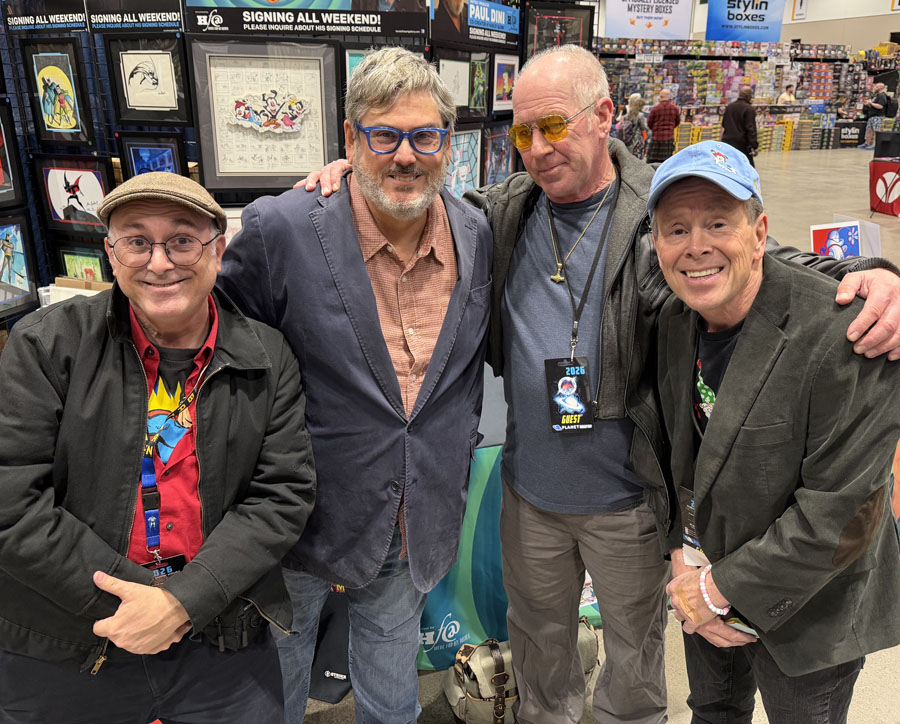
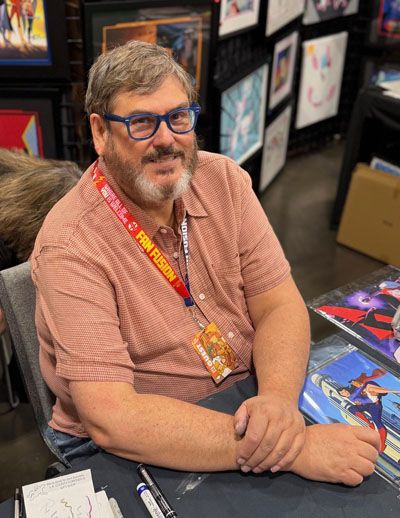
All Heroic Fine Art Gallery photos courtesy of James Fletcher.
Heroic Fine Art Gallery at FAN EXPO Anaheim, June 26-28, 2026, ARTIST ALLEY P54-P67. Featuring Tom Ruegger (co-creator of Animaniacs, Pinky and the Brain, Tiny Toon Adventures; writer/executive producer on Batman: The Animated Series), Paul Dini (Harley Quinn co-creator, writer/story editor/producer), Kevin Altieri (artist/director), Dan Riba (artist/director), Frank Paur (artist/director/producer), Alan Burnett (writer/story editor/producer), Bradley Charles Rader (artist/storyboards), Stan Berkowitz (writer/story editor), John Calmette (background painter) and Eric Radomski Art by Radomski (artist/creative director).