Mickey Mouse is an cartoon character co-created in 1928 by Walt Disney and Ub Iwerks.













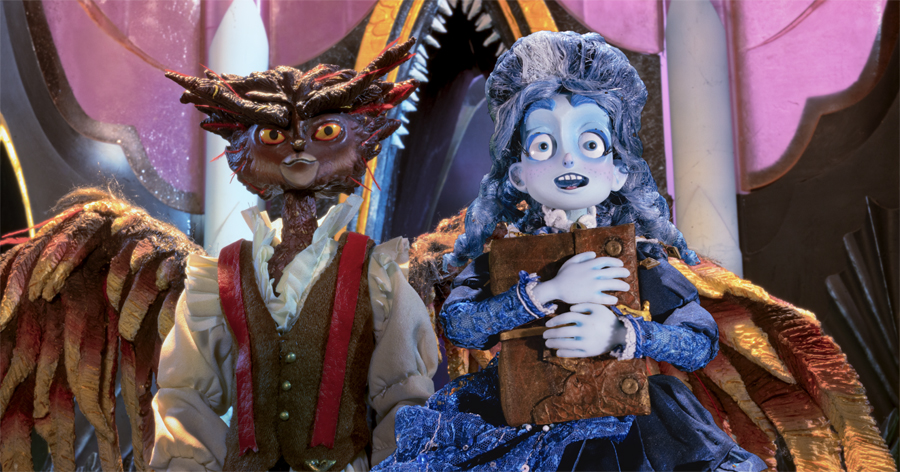
Roy and Arturo Ambriz had a dream to make Mexico’s first stop-motion animated feature, and, after nearly a decade, despite numerous financial setbacks, including the mortgaging of two homes, the brothers finally succeeded with the help of their mentor, Guillermo del Toro.
The result is I Am Frankelda (streaming on Netflix June 12th), a prequel to their popular anthology TV series, Frankelda’s Book of Spooks, made at their family-run animation studio in Mexico City, Cinema Fantasma. The wildly ambitious and colorful horror musical follows a Mary Shelley-inspired young writer in 19th century Mexico, who travels to a parallel realm of her imagination (Topus Terrenus), where she encounters a strange symbiotic relationship with her spooky characters. A power struggle for creative dominance ensues between Frankelda and Procustes: a giant spider-like authoritarian figure who serves as the master storyteller of the realm.
What began as a special for HBO Max, grew in scope into a feature, largely self-financed by the brothers. After opening the Guadalajara International Film Festival, and screening at the Annecy Festival and Fantasia International Festival, the film received a successful theatrical release in Mexico, before Netflix picked it up.
I Am Frankelda serves as a rallying cry for Mexican artists to never give up the passion for their art, despite constant rejection. For the Brothers Ambriz, this was a very personal passion project, culled from their own frustrating experiences as filmmakers. On another level, it’s about the particular frustration of being a female writer trying to succeed in a paternalistic world.
“It has been really difficult for us to produce our own films,and there has been a lot of people trying to stop us or telling us that we’re not worth it,” Arturo said. “So that’s why we wanted to create this film to tell all the audiences that they should fight for their dreams and to continue doing that because it’s important for society and for us to know their voices.”
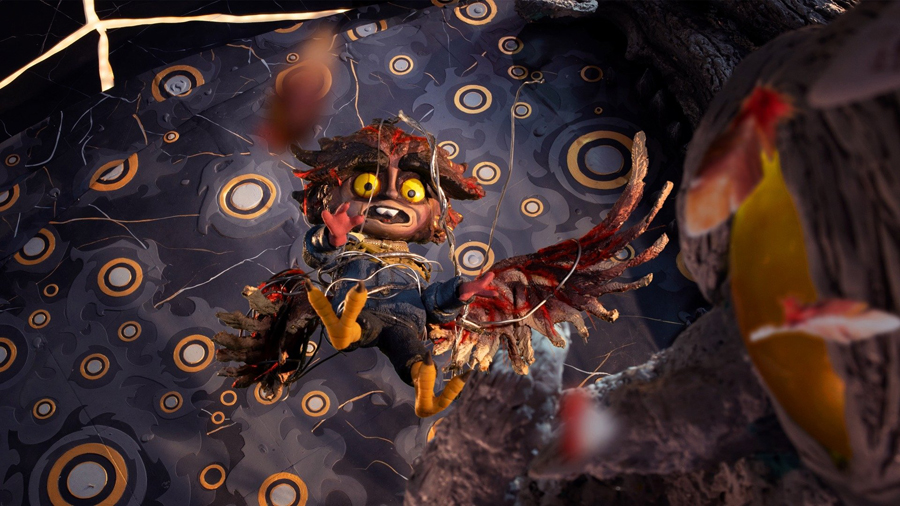
After the success of the series five years ago, the brothers discovered that Mexico didn’t have the infrastructure to support a stop-motion feature. But they persevered to make their breakthrough film, which can now inspire further movies.
Enlarging the scope of the film was obviously the biggest challenge.“My brother Roy and I really wanted to create a world of monsters in which civilization and art history was at its peak,” added Arturo. “So they are like in the renaissance and the level of their architecture, their language, their wardrobe is very exquisite. So that’s a way of upscaling the whole production because it’s like making a stop-motion film in the renaissance.
“I mean that’s really, really difficult,” Arturo continued, “because of the level of sculpture and everything. And to have this fantastic and exquisite world, we had to build a lot of sets, a lot of garments, a lot of props, and that helped us to define the production design of this whole film.
It took three and a half years and a significantly larger crew to tackle the film. “We take it for granted how difficult it would be to set up an infrastructure,” Roy explained. “It’s not easy. We have been living for 15 years doing stop-motion daily in Mexico. And it is really hard to find the objects and to finish the projects. And what happens in Mexico is that there are some national funds that are not enough in order to do the film. But we didn’t win anything of that.So we have to find other ways in order to make this happen.”
The world building alone was challenging yet thrilling, drawing on film favorites (The Labyrinth, The Dark Crysal, The Neverending Story) and Mexican folklore. “It was a great opportunity to build a civilization, to try and understand their core values, and the way they manifest themselves,” Arturo recalled. “We are just representatives of a big team of artists and designers and people who really want to take this chance to something unforgettable.
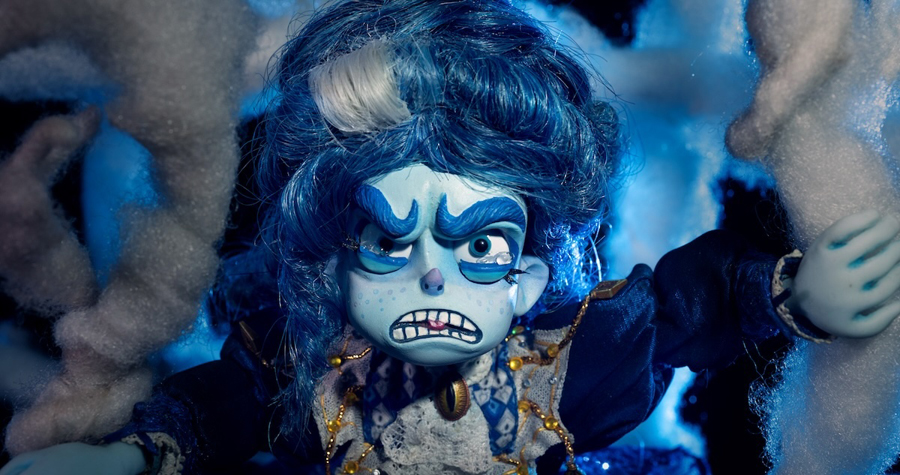
“We use some Mexican folklore figures like El Coco, a kind of boogeyman. Or Chupasagre, the bloodsucker,” added Arturo. “But almost all of the other characters and mythology, we created from scratch. We love mythology, so we wanted to create our own. And even though everything passes through a lens of how this would work in Mexican culture, all the rules of the world and all the myth behind this story is invented for us.”
With 200 puppets, they economically worked at three different scales. “The main one, we call it the hero scale,” Roy explained. “They’re like the size of a Barbie doll. We also have a mini scale and we used them for wider shots. And we have one smaller scale that’s micro, the size of a coin. And it’s used fo really wide shots. Because one of the main objectives was to create a really immersive world that felt huge. And in order to achieve that, we had to use these micro puppets with such large sets.”
Not surprisingly, the villainous Procustes was the most complex. He has eight legs, two hands, 60 different mouths, eight fingers, a weave, a mustache, and armor.
“We tried to make him a character that you would love to meet,” Arturo said. “He’s very charming and entrancing, but he’s so grotesque. You want him to go away because he smells really bad but puts on a lot of cologne. And his huge legs filled with hair give you goosebumps. So animating it was very difficult. He’s never static. He’s always moving. Sometimes he’s hanging from the ceiling or walking on the walls, so it was a great challenge for the animators, the rigging department to have him ready for each shot.”
The brothers acknowledged the invaluable assistance of del Toro. “His contribution has been tremendous,” Roy added. “He gave us tips for storytelling, of even framing shots, pacing, and also about distribution, sales, representation. And, even though it was really difficult, it gave us freedom in order to search new paths of production and to connect with audiences in new ways that other producers have not explored before. And we hope that this film helps other filmmakers to see that you don’t have to wait for someone to give you permission in order to do your films.”