Mickey Mouse is an cartoon character co-created in 1928 by Walt Disney and Ub Iwerks.







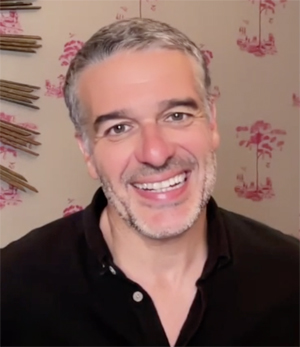
Ben Gregor is the director of the new family film The Magic Faraway Tree, based on the iconic books. It opens in theaters in North America this Friday Aug. 21. He joins me to discuss the film’s dynamic animation and VFX elements, a love of stop-motion movies, and how this serves as a companion piece this summer to Toy Story 5. (This Animation Scoop Q&A was edited for length and clarity.)
Jackson Murphy: The movie has already played overseas, done really well overseas at the box office. That’s gotta make you feel good.
Ben Gregor: Yeah. We were really thrilled. It’s a big, universal family movie. I think it’s a real theatrical movie. I’ve just been amazed by how good the theatrical experience is these days. Thesound, the Atmos sound, laser projection, whatever. When you go to a theater, it’s an amazing experience, and to suddenly realize that our movie is a big walloping film that wallops into people’s faces with color and heart, and music from Isabella Summers… I just thought, “Wow.” I’m glad it has connected, and I want it to connect more, and I’m so excited about it coming out in America.
JM: It’s a big summer for family films in theaters, and this is one of the big movies, and I think families are really going to take it all in.
BG: Come on now. Come on, America!
JM: That’s right. Did you feel a huge sense of responsibility because these books are so beloved, along with the great themes that this movie talks about?
BG: I felt absolutely no responsibility. I feel like we had to be brave. We had to feel it ourselves. Simon Farnaby, I knew I had a great partner in crime… He did “Paddington 2”. He knocks it out of the park. You know, we love [Enid] Blyton. We love this tradition of storytelling, of Hitchhiker’s Guide to the Galaxy, Lord of the Rings, Narnia, and this is all grounded in domesticity, the UK, and then suddenly goes mad. Suddenly goes off and does crazy stuff. So in a way, we’re just so innately feeling that when we do it. So we didn’t want to be hemmed in, but we also really wanted to respect that people love the books. But more importantly, we wanted to show them that we were true-heartedly going to make this big, and so that’s what we did. So we modernized it. Simon was really interested to explore what modern kids would do in this settings, ’cause in, in the books, the kids are, “Oh, golly. Thank you for letting me do my chores, Mummy.” And now it’s just like, “Ugh, no. What? Where’s the wifi code?” To see those guys transform, to see those guys feel what it’s like to take a risk and go out and go up a tree, a dangerous tree was so fun to film.
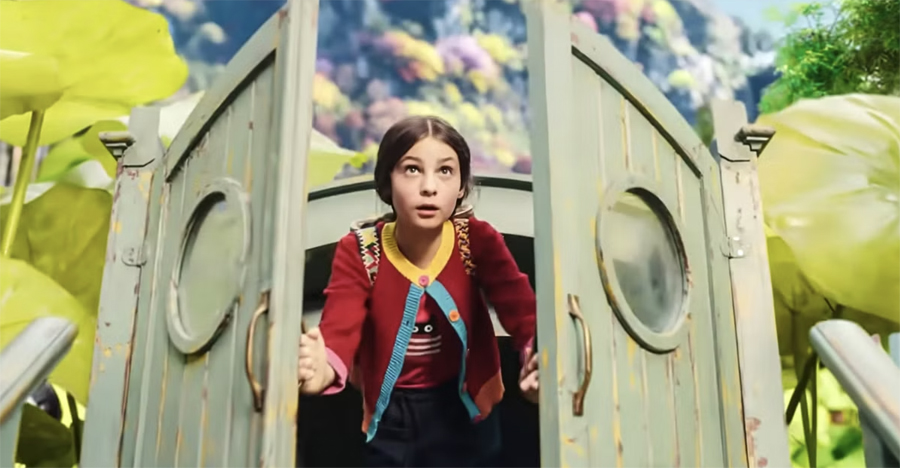
JM: The Thompson family moves from the city to the countryside. Their life changes forever. A pivotal moment early on is the smart fridge… Is she really voiced by Judi Dench? Is that true?
BG: We have Judi Dench, yeah. Judi Dench just begging to be in The Faraway Tree. We had Judi Dench, Michael Palin, legends, legends everywhere. And our cast of Andrew Garfield, Claire Foy, these are big-hearted, kind, generous, funny actors who just loved the material, loved Simon’s writing, and loved the chance to play.
JM: When I watched the movie, I was really impressed with Andrew Garfield and Claire Foy especially, because what they have to do as the parents is carry a lot of what’s going on, also interacting with the children, and they are so game. They are so all in, and you can feel them being genuine.
BG: Everybody went for it. When we finished shooting, we started putting it all together, we suddenly realized it was a really moving film. It is on the page, but it’s so challenging to make that you just get mesmerized by, “How on Earth am I gonna do that? What? What?” Everything was like a puzzle. But then when you lay it out, Simon’s so clever, he’s such a clever writer, that you realize, “Wow, there’s a real emotional coherence here. This is a story, a universal, big story, like a big Spielberg story, of a family coming together.” Of taking risks and all there.
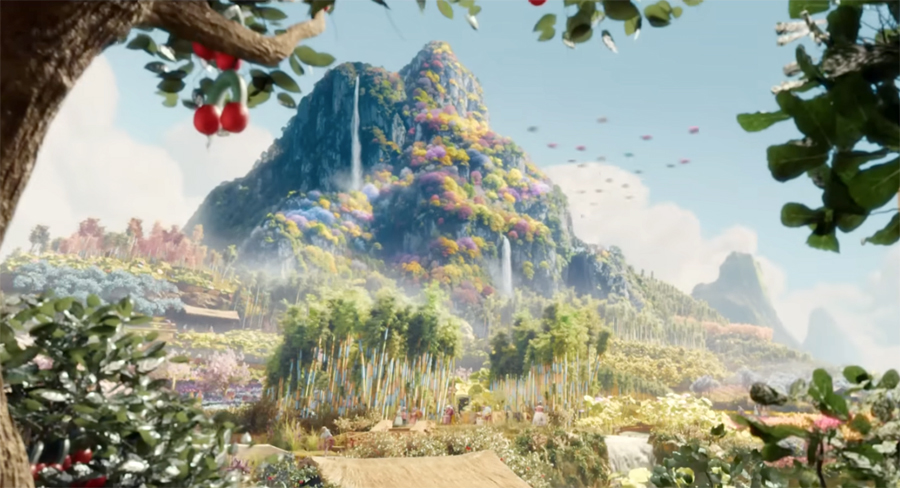
JM: And the moving elements of the movie really start when Fran enters the woods. Fran is one of the Thompson children, and she goes into the woods, and the tree moves and you feel that emotion starting from that point. Tell me from the animation / visuals perspective about the tree, about creating that sequence and establishing all of that in this world.
BG: We had two challenges. One which is to make it big scale and spectacular and magic. And that’s VFX. That’s making the visual effects crafted, loved. We brought the team in. We made our own visual effects company, and we sort of occupied an abandoned building above a subway station, a tube station. And the VFX guys were in the heart of what we did. And I made them a song, like a thrash metal song, called “VFX Revue”, that we play at the beginning of every VFX review. We had a blast, and they were really amazed and happy to be at the heart of theprocess. I’m a big admirer of “Godzilla Minus One” and how they made that. The director was on a chair rolling around. There were no reviews. It was just all crafted. And so I wanted the VFX to feel really crafted and be really preciously celebrated, and the animation and the 3D and all that stuff. But by the same token, I needed the kids to see stuff, feel stuff, eat stuff. So we built the biggest sets we could, and most of the things they see and touch are actually there. The set was edible, the Land of Goodies, the candy sets. And that gave us amazing textures to anchor onto for VFX. It was combining the experience for the cast on set with spectacular VFX. That was the challenge and the joy of the film because we needed both.
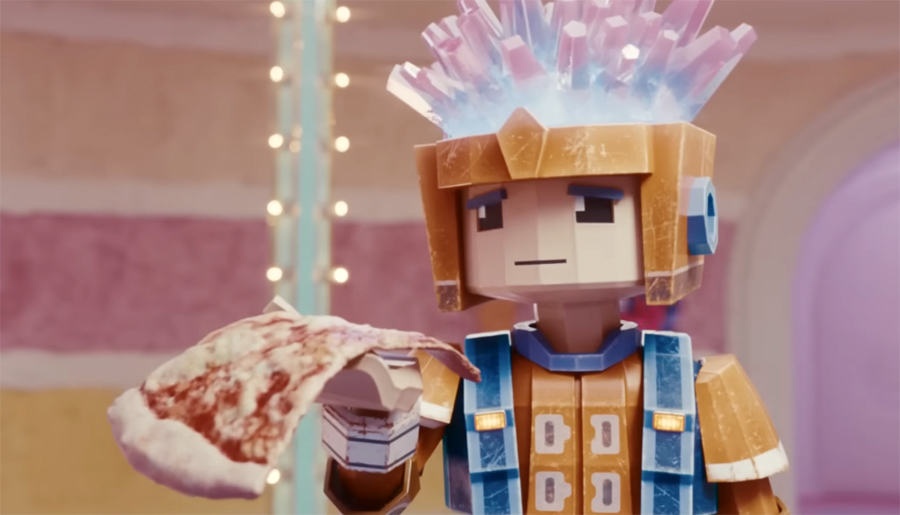
JM: The boy in the Thompson family, Joe, at one point becomes his Mineblast character. Was that a lot of fun to design the animation for that character?
BG: Yeah, totally. That was Tim Ledbury, the VFX supervisor. He just told me what he wanted to do. I think the most powerful words as a director are, “I don’t know.” You have to care, but you don’t have to know. Because if you’ve got good people around you and let them do their first draft idea of just what they think the very best thing is, then you’ll get amazing stuff. We’re too used to editing each other’s stuff. We’re too used to saying, “Oh, make it a bit more this, make it a bit more that.” There’s a whole thing in VFX industry of notes coming in meaning that… they’re spending all their time doing versions. So I wanted people to think on this film that the first draft of what they did could really 100% make the cut. So Tim just really wanted to design that character. I think I had very little input into what that looked like. I just said, “That’s amazing. Do that.”
JM: There’s also a bus plane sequence later on in the movie. That’s a lot of fun for the characters. Designing that — what was that process like?
BG: That was amazing. Again, the guy just designed it. And I was like, “Wow, that’s a bit like a tram, from Lisbon with wings and a biplane.” And I was like, “That’s absolutely brilliant.” I would have had no idea. I didn’t say like, “Do me a tram with wings.” I’s just what he wanted to do, and I like the idea of a propeller at the back. But ultimately, because we got it designed quickly, it meant we could build it. So rather than dithering around, we just went, “Yep, yep, let’s do that.” Instinctive, done, move on. And so then they built the thing, and then all the instrument dials worked. So that meant that when the kid, Phoenix [Laroche], playing Joe, sat there, he was holding real stuff, and everything was really moving. And the things he could tap, he could see. By kind of going with people’s first draft and building it quick, it gave you more time to just physically create it rather than have meeting number three million about the thing that you end up running out of time for, which is so easy to do.
JM: I feel like this movie is a great companion piece this summer to “Toy Story 5”, because both movies tackle technology head-on. What did you really wanna say about that? And you’re pretty blunt with it, which I applaud you for.
BG: It’s not a preachy film about “technology is bad”. It’s a different landscape. I’m a parent, and you have to answer emails on a Sunday night. No one had to do that before. So then what, you can’t… how can you be present for your kids if you’ve gotta do an email? And you can’t go on screens, they’re bad, meanwhile I’m on a screen. The whole setup and expectation of being a parent these days is really hard, so I have a lot of compassion for it. Adventure is good. I love “Toy Story”. I love Pixar. It’s interesting to think about animation because for me, animation is, from a writing perspective, before the Simon Farnaby era, it was way ahead, the writing, and imagination in animation from live action family films. You know, look at “Coco”. Love “Coco”. Amazing. The idea of a dad as well, it’s so sophisticated. The dad in “Coco”. “Mitchells vs. the Machines”. “Up”. “Toy Story” of course. “Toy Story”’s amazing. I liked “Toy Story 5” a lot. I loved going to see that. A live action [Studio] Ghibli is what I wanted it to feel like. The kind of feeling of going to the countryside, and that bit where they walk over the hill and you see the clouds, that’s just pure Ghibli for me. I think Pixar, Ghibli, the way that animation can move you… and I cry. I get in a lot of trouble actually, because I only really cry at animation. And it’s like, “Why can you cry at animation and not about real life?” And I’m like, I just find it just opens me up, and I wanted to think, “How can I do that in live action? How can I make people cry in this film and give it that honesty?” And that’s what I try to do. The film makes me cry. I cry four times when I watch “The Magic Faraway Tree”. But other people do cry. It does make people cry.
I’m a huge animation fan. I’m really excited by “Wildwood”. I love Wes Anderson’s animations. In fact, we had a lot of the “Fantastic Mr. Fox” crew on this. The designer and the VFX guy worked with Tim Burton on… “Frankenweenie”. We approached this in a stop-motion way, which is that VFX and design are at the beginning. You work out what you’re gonna need, and you’re aligning them so it does… so we had this sort of aesthetic that comes from stop-motion, and which can really teach you when you’re doing a more technologically kind of way of using more technological tools and 3D. All these different things. If you take it from a workflow stop-motion kind of way, it actually makes people more aligned and more playful because they’re mucking about earlier on. They’re in on the concept stage. They’re in at the very beginning as opposed to,”Here’s what we’re doing. Execute this,” which is not the way I like to work. I learn a lot from animation, both as a fan of it and looking at the workflow. It can teach you a lot in live-action.
JM: Yes. I love that you love animation so much. I could talk to you all day about it.
BG: Totally.
JM: And “Fantastic Mr. Fox”, by the way, is one of my all-time favorites. So congratulations on this.
BG: It’s been really fun talking to you, Jackson. You’re brilliant. Thank you.