Mickey Mouse is an cartoon character co-created in 1928 by Walt Disney and Ub Iwerks.










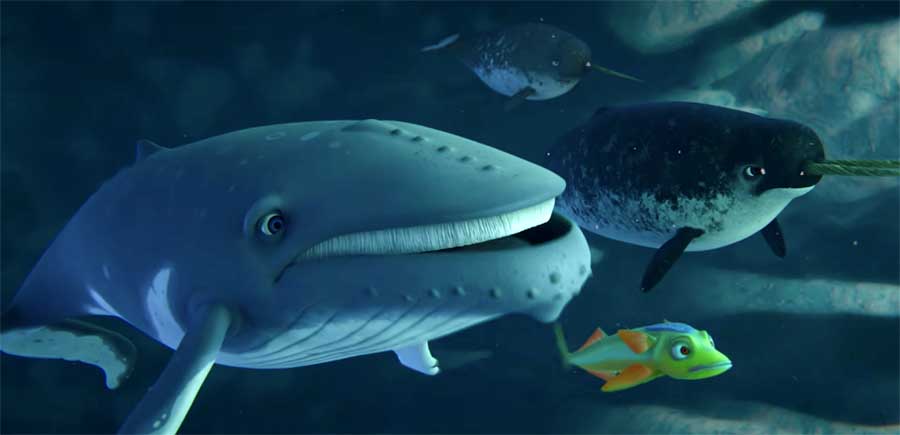
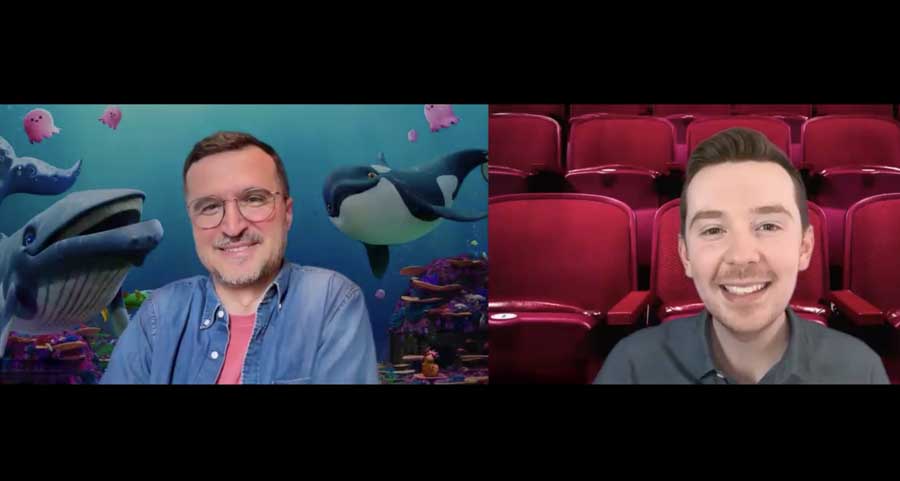
Reza Memari is the director of the new animated feature “The Last Whale Singer”, in theaters nationwide next Friday June 5th. It’s about a Humpback whale named Vincent who, a decade after losing his parents, must find his song in an effort to protect the oceans. (This Animation Scoop Q&A was edited for length and clarity.)
Jackson Murphy: I first want to ask you about your love and fascination with nature, and all the creatures of nature. Have you always had that throughout your life?
Reza Memari: Yes, but also I think animation just lends itself so well to using animals for expressing all your inner feelings and doing your own therapy kind of thing. (laughs) And in this case, because of whales, it was just so perfect, because when I heard that whales have a song, and that they have singers…. And that they learn a song, and then they recompose their songs, all that stuff… I was like, “Okay. I gotta make a movie about this.”
JM: That’s a great hook for an animated feature. You have Vincent the Humpback whale, and you establish early on his close relationship with his mom and dad. How important are these scenes, especially with what happens over the course of the movie, to establish it tonally in the ways that you wanted to?
RM: Well, I think the parent connection is always very important. Of course, it’s a family movie, so parents are super important. And I grew up with ’80s Disney movies, and I know what that means to have the parents and then have them yanked away, and then the hero has to deal with the world, the big, giant world on their own. So I think that’s kind of the inspiration I was following, as well, on “The Last Whale Singer”.
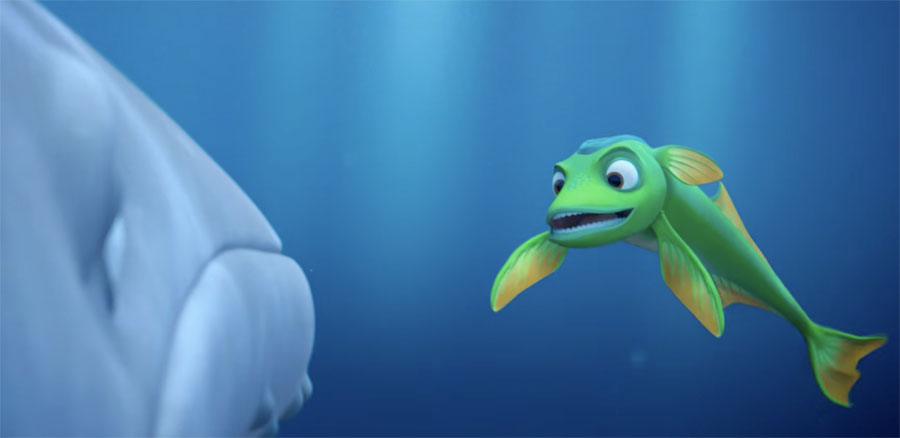
JM: Yeah, that makes sense. And then you have Walter, who is this fish, this caretaker, this guide for Vincent, looking out for Vincent. And that’s important to have a friend, a guardian, a caretaker who can do that in a child’s life — in anyone’s life — and that’s important that you establish that here, too.
RM: Yeah, Walter is super, because he’s also the comedic relief character. But he was interesting because I wanted a comedic relief character who doesn’t get on your nerves. You know when cartoon characters that are supposed to be the funny ones aren’t funny, and not warm… And so in our case, I think we managed to pull it off so that Walter has the warmth, and the character. And also some good jokes.
JM: Yes, absolutely. As you mentioned, this theme of finding your own song, which is so prominent in the movie, and you mentioned first hearing that and going, “Wow, this has to be this movie.” How deep did your research go when it came to that, and what surprised you about all that, and the elements you wanted to incorporate into this film?
RM: Well, the funny thing is we only know 20% about the oceans, so there is so much we don’t know. That’s the first thing I found out. And there is also so much we don’t know about the whale songs, and why they sing. We don’t even know why they leap out of the water. It might really just be for fun and showing off. And so, I did a lot of research. I went on whale watches. I just tried whatever I could to learn as much as I could about all the animals in the film, because to me, it was very important to stay true to these animals and not put on ‘just a human in a fish costume’ kind of thing. So the animators had to go through rigorous… I think our animation bible was 200 pages long because they had so many characters and so many species to deal with. I think we go across the whole spectrum of marine species in this film. And it was quite a lot to learn… “How does a sea cucumber move?”, for example.
JM: Wow. I went whale watching in middle school, and we only saw about a whale and a half. When you went whale watching, what kinds of experiences did you have? Did you see a lot of great whales?
RM: I was in Cape Cod, and that was my first time, actually, and I was already researching for the film, and I was like, “Let’s do it. I’m already in Massachusetts, let’s do it.” And then it looked like there would be no whales because there was incredible fog. And the [captain of the] boat was already saying, “We have to turn around, there’s not going to be any whales.” But then magically the sky opened up, and suddenly there was this ray of light, literally, and one whale was in this opening, in this clearing, and he leapt out of the water, and his name was Acorn. He had a name. I think he gave us a show for 20 minutes, and I couldn’t stop crying. I don’t know if you cried, I cried non-stop.
JM: Wow. That’s amazing! I’m glad you had that experience! That’s incredible — and an incredible research and an influence on this film. There are visuals in this film that are so striking because there’s a section where the characters get to parts of the ocean with lots of trash, and obviously there are themes about protecting the environment in this movie that are so important. cCeating those moments, I look at it and go, “Wow.” You show a lot of trash in the ocean, which is so unfortunate, parallels to real life, and I think that’s gonna impact a lot of people.
RM: Yeah. I think a trillion pieces of trash that we had to procedurally generate for this film. We made the film partially with Unreal Engine. And so that was really helpful to use this technology to just create a lot of procedural stuff. You can’t make an ocean film these days without actually showing the trash impact that humans are leaving behind.
JM: That’s gonna stay with people for a long time — also, I think the themes of loss and memories, and you deal with that in a number of different ways over the course of the film. Memory is powerful. Loss, it can be tragic, it can stay with you. We flash forward 10 years at one point in this movie. So how did you want to approach that? You mentioned the influence of the Disney movies — but approaching all that while still making this a fun film for families.
RM: Right, totally. Yeah, I think it’s a good question. I think it’s really about overcoming grief in a way, and kind of embodying the next generation, as cheesy as that might sound, and understanding the heritage that you have been given by your parents. And just kind of continuing that song, literally. I think for the longest time, Vincent, our hero, rejects or refuses this call and doesn’t want to do it. And then, finally, when he does it, I think that’s when the story also… you start to connect with him more, because you’re like, “Oh yeah, he finally got it. He has to follow his calling.”
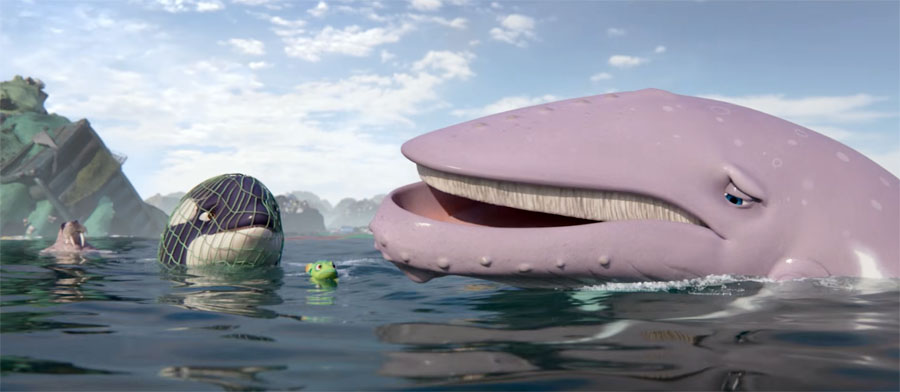
JM: And then you have Darya, who’s a great character, the orca, and her senses, and you explore all of that in very interesting ways as well. What was so important to you about Darya?
RM: Well, Darya is deaf. She lost her hearing because of dynamite fishing. Another thing I wanted to show how we keep interfering and messing with the marine world. And, in her case, she couldn’t care less that she can’t hear. And in fact, she basically strengthened her other senses so she can feel vibrations in the water more finely than any other creature. And she can do orcarate [pronounced Or-Karate], which is my big joke for an orca. She’s a badass. I really love Darya. And I should say that we talked with hard-of-hearing animators and got some consultation to make sure that the jokes hat we’re kind of doing in the movie work even for the deaf community.
JM: Fantastic that you were with them during the process of making this movie, and I think that families are gonna love the journey that this movie takes us on —
the journey for these characters. How does that speak to you, the theme of a journey and an ensemble piece? You have several characters going on this journey — kind of a staple of animated features that you were really able to explore here.
RM: Exactly. To me, an animated feature always almost has to have an epic journey element to it. What else can you do? It has to be a road movie, and it has to be a bunch of characters… a funny, strange pack of animals that don’t really match, but somehow get together and find a way to work together, and become great friends, and then solve this big problem that is threatening the world and the oceans.
JM: Yes. Protect the oceans. It’s a major summer for animated films, Reza. I’m sure you know that, and you are a part of it with “The Last Whale Singer” being in theaters. What does that mean to you?
RM: Yeah, I’m particularly proud of this U.S. release, because it’s gotten incredibly hard to even get anywhere in the U.S. as an indie film. So it’s been really great to have this opportunity to launch in the U.S. in June. June 5th, it’s just the best. I feel like I’m dreaming. It’s really cool. I love it.