Mickey Mouse is an cartoon character co-created in 1928 by Walt Disney and Ub Iwerks.






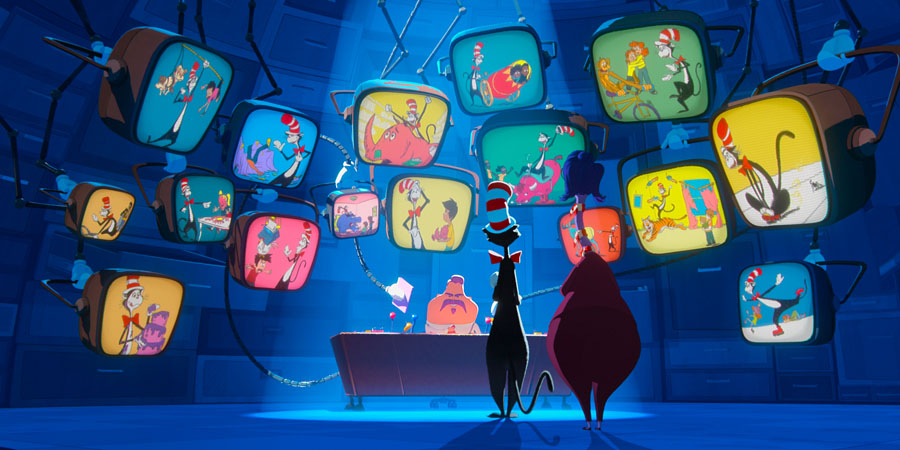
With The Cat in the Hat, Warner Bros. Pictures Animation fleshes out the chaotic world of Dr. Seuss’ tall, anthropomorphic, mischievous feline (voiced by Bill Hader) in CG ,but in keeping with the author’s graphic style. It takes place after the book ends and with a lot of imaginative surprises.
As an agent of the I.I.I.I. (Institute for the Institution of Imagination and Inspiration), The Cat always manages to mess things up. But he has one last chance to prove himself by cheering up siblings Gabby (Xochitl Gomez) and Sebastian (Tiago Martinez).
Directors Erica Rivinoja (showrunner for the Clone High reboot) and Alessandro Carloni (co-director of Kung Fu Panda 3) were inspired to discover the truth about The Cat, especially what his job is as maybe the greatest child pyschologist ever.
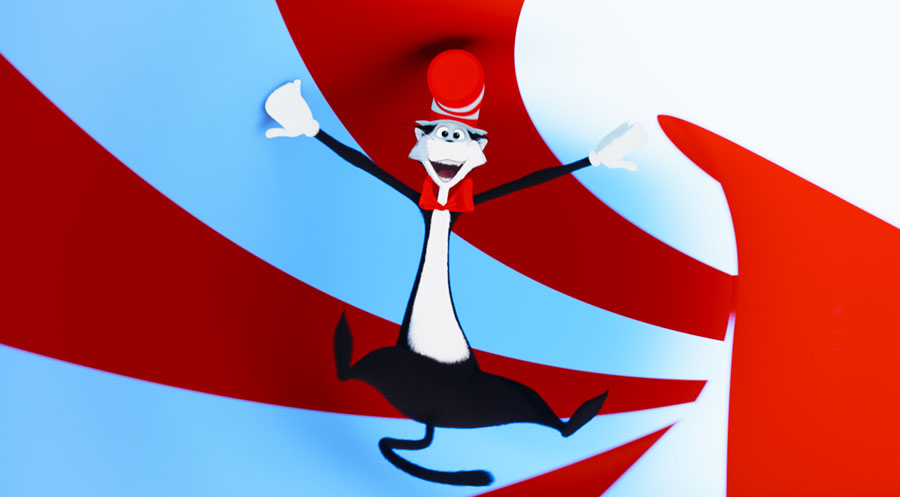
“It’s a very small book but what really launched the movie for us was: Why did this book happen? Why did this cat show up to these children’s house on this rainy day? Why does he have that red and white stripped hat?” Rivinoja said. “Once we started asking these questions and looking for answers, that’s when we came up with the whole idea that this is his job. He’s one of many different specialists who’ve entertained more children around the world, and that opened up this entire world for us.”
With the help of production designer Aidan Sugano and head of story Ryan Gaffney, they adapted the visual style of Theodor Geisel’s Seussian world to 3D (animated by DNEG). There were three worlds with distinct looks: The Real World, the Seuss World and the Worlds of the Boxes. The first was simple, tactile, rich, and naturalistic. The second leaned into a modern interpretation of irreverent whimsy with dynamic color, composition, and playful surrealism. The third was comprised of landscapes of personality and memory, conveying visual depth of a character’s identity and experiences, with a graphic 2D look yet expansive 3D depth and space.
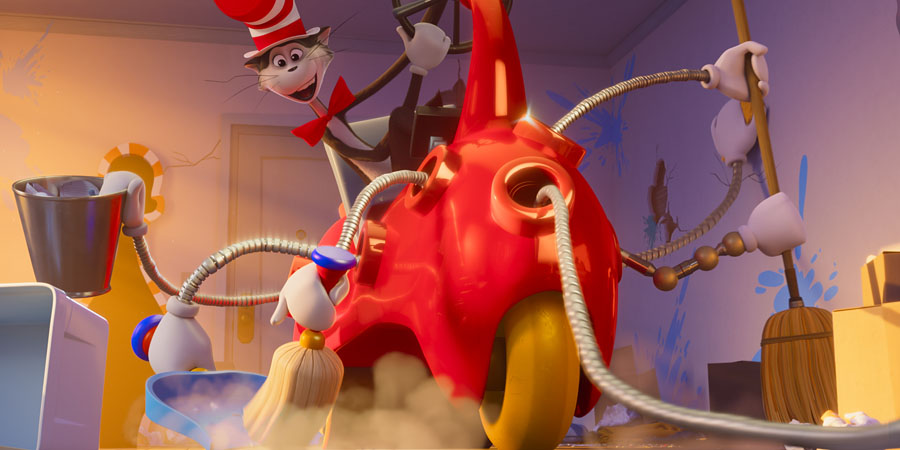
“It felt very organic to the story, too, because when we’re in the Seussian world, we really wanted to pay homage to Geisel and to his whole style that is so iconic,” added Rivinoja. “So that’s why when we’re at The Cat’s office, you’ll see a lot of that negative space and those hatch marks and those certain palettes that Seuss used and the whimsical arches and staircases. But the story is one of the few where a character from a magical world goes into the real world, and so we thought that was a natural transition to then go into what became the real world.”
But leaning into a handcrafted look overall was a lot of extra work. The key was to get to a place where the viewer wasn’t sure about the technique. “Is it CG? Is it hand-drawn? Is it painted backgrounds?,” Carloni said. “Some journalists have asked what it is because they’re not sure what they’re looking at, which is exactly what we were hoping for.”
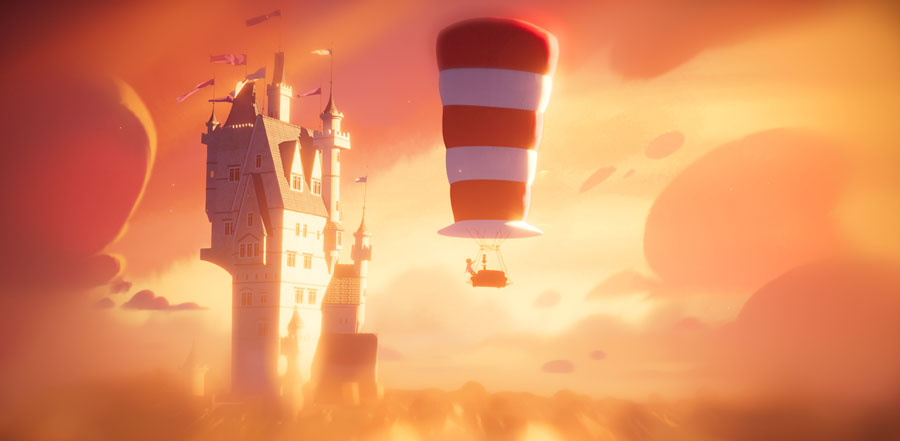
One of the favorites for Rivinoja was when they venture into the mom’s (America Ferrera) moving box. “Because their impression of mom is that she’s like all adults,” she explained. “She just loves paperwork and documents. But then, without giving anything away, they uncover who she was growing up and all of this dimensionality that they didn’t know about their mom. And I think that’s such a wonderful reminder to families that your parents were people before children came into their lives, but also a reminder for parents that their children are full of depth.”
Another aspect was the introdution of Thing One and Thing Two (which is a planned spin-off movie), which expanded into more Things. “When we asked Seuss Enterprises about maybe there being more Things because they are such icons in that universe, they were very excited about that,” Carloni added.
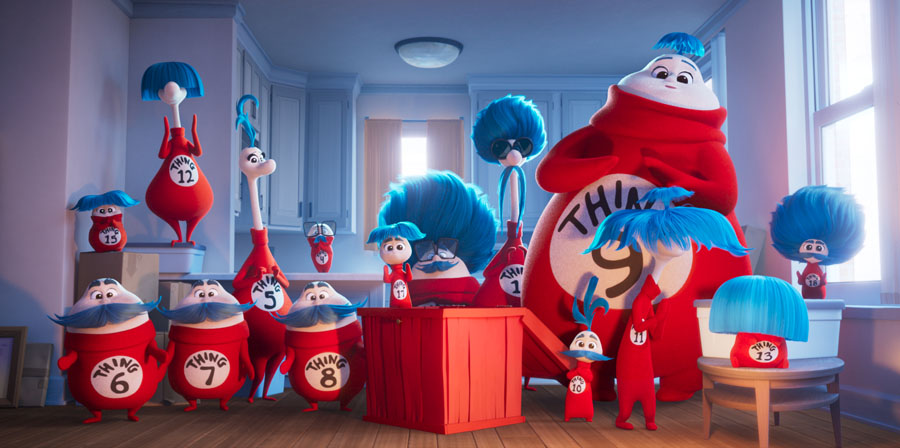
“And then when we proposed the idea of the Things actually looking different from Thing One and Thing Two, and they were open to that, we were just blown away,” he continued. “It just opened up the entire world for us. And we could suddenly have The Things bring chaos beyond infinity. Our story didn’t change too much, but one thing that changed a little bit was the fact that, in our test screenings with our peers and bosses at the studio, people really responded to our Things. They were not really meant to be in the third act, but they requested to put more of them after we came up with something that they responded to. So we added them to the rest of the story, and they had to open up the purse strings.”