Mickey Mouse is an cartoon character co-created in 1928 by Walt Disney and Ub Iwerks.









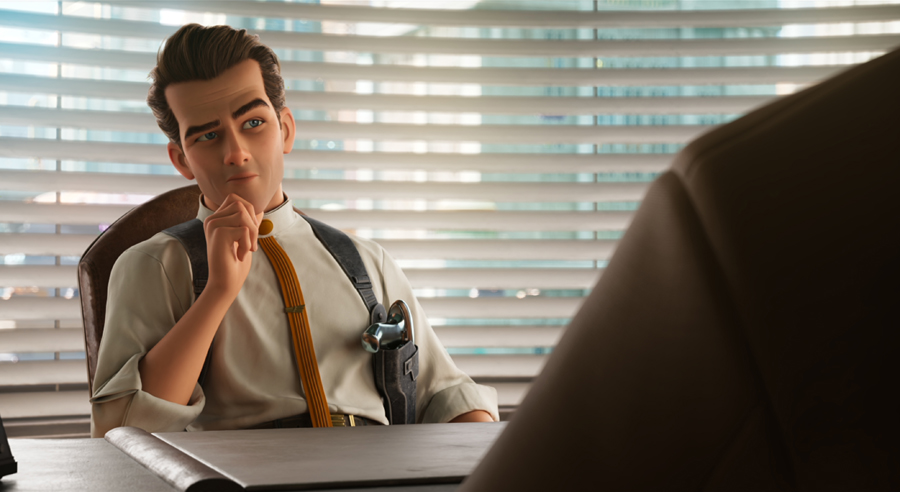
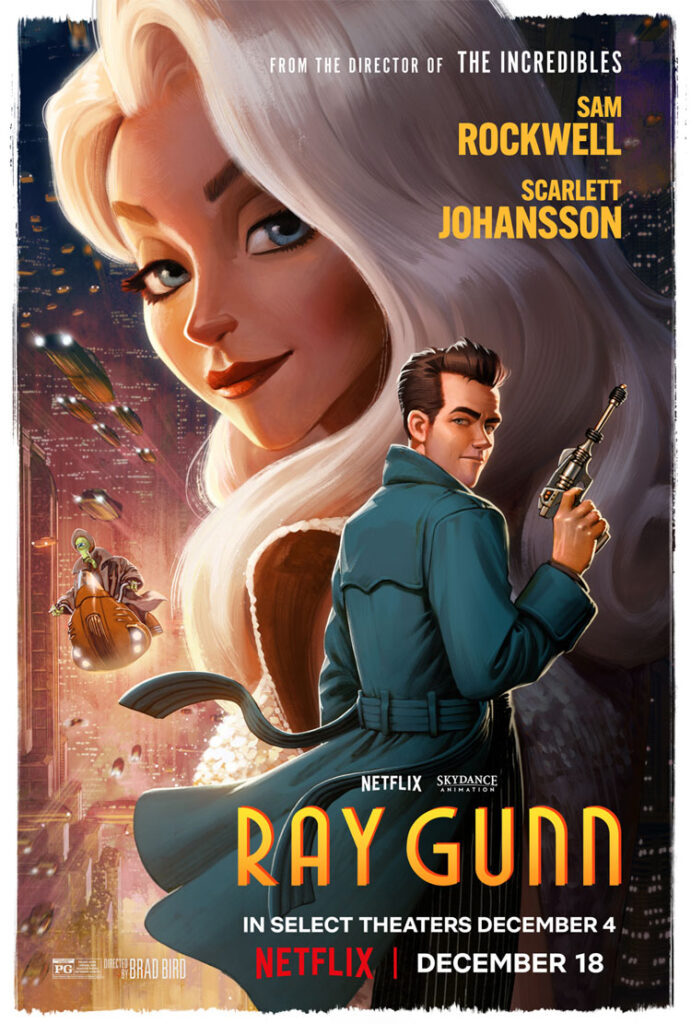
At a recent Ray Gunn press day at Netflix (ahead of the December 18th streaming premiere), Animation Scoop got a glimpse of the first 30 minutes of Brad Bird’s sci-fi/noir passion project, and was treated to a revealing behind-the-scenes peek at the creative process. Netflix also dropped the first trailer today along with the announcement of voice cast members Alan Tudyk, Matt Berry, Bobby Cannavale, Michael Chernus, Kether Donohue, Michelle Rodriguez, Aasif Mandvi, Matt Jones, Kathryn Hunter, John Ratzenberger, Justin Peck, and Patton Oswalt.
Ray Gunn was intended to be Bird’s first movie 30 years ago, but it was rejected by Turner Feature Animation and Warner Bros. for being too risky and too adult, and the director pivoted to The Iron Giant (1999), which many now considered this country’s last great 2D movie.
Judging from the footage, Ray Gunn represents the culmination of everything we’ve come to expect from Bird’s animated movies: smart storytelling and visual flair, but with greater emphasis on action and humor.
“This one took way longer than I ever imagined it would,” Bird told Animation Scoop. “I had given it up, too, and the fact that it came back to life and got realized [at Skydance Animation and Netflix] is amazing. It was a big bite and I had less experience, so it worked out.”
But not making Ray Gunn in 2D, as he originally intended, didn’t phase Bird. He credits the latest CG tech advancements (courtesy of Cinesite as Skydance Animation was spread too thin) for providing eye-popping naturalism and dynamic camera movement. Bird also benefited from the character design of Pixar alums Teddy Newton (Monsters, Inc.) and Tony Fucile (The Incredibles).
“I feel like there are advantages to animation that are right there to use, one of them being caricature,” added Bird. “But while the story hasn’t really changed, the new tech allowed me to do so much more cinematically than with 2D animation.”
Ray Gunn is set in the retro-futuristic world of Metropia in 1939, where humans co-exist with aliens. We follow private eye Ray Gunn (Sam Rockwell) — the last of a dying breed — who investigates a murder involving femme fatale pop star Venus Nova (Scarlett Johansson). The hard-bitten yet plucky Gunn works alongside loyal sidekick Eyera (Tom Waits), a green, one-eyed alien, who functions as a living camera on a tripod with spidery legs.
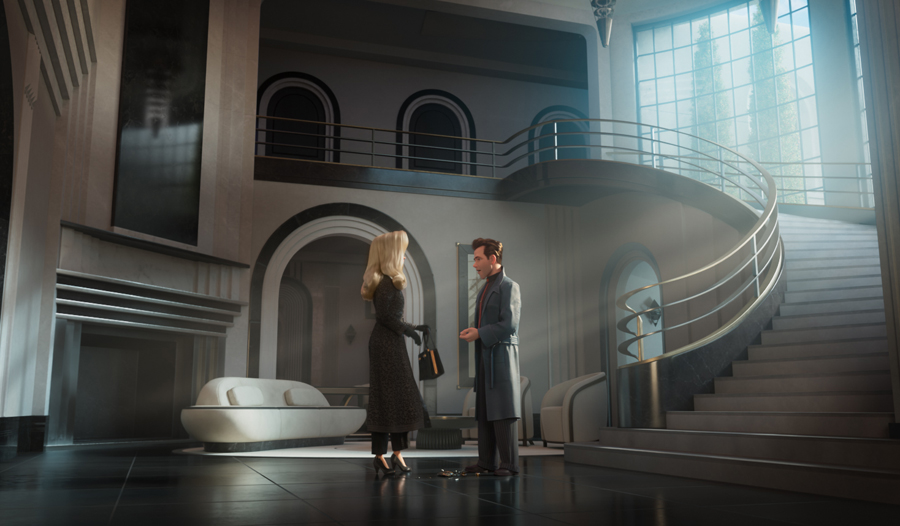
Nostalgia Meets Noir in Metropia World Building
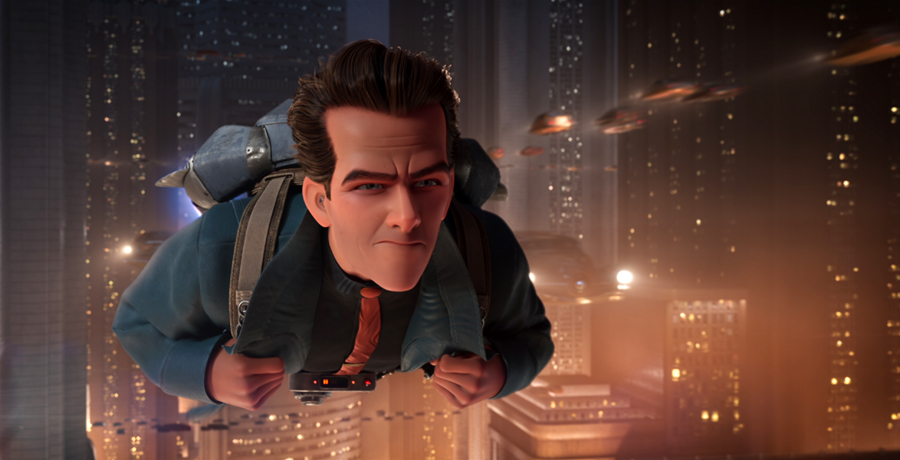
For the retro-futuristic Metropia, Bird wanted to combine the ’20s architecture of Hugh Ferriss, who was known for towering skyscrapers, mixed with the streamlined, modern style from the late ’30s (for both buildings and vehicles). We get a glimpse of this in the opening panoramic view of the contrasting skyscrapers and cityscapes, with flying cars, monorails, jetpacks, neon billboards, and Venus holograms.
“You have these monumental, tall, stepped buildings, which are very blocky, square, and vertical, combined with a totally different idea, which is the Streamline Moderne,” said Wendell Luebbe, the art director from Skydance Animation. “It’s horizonal with curved corners, circles and geometry. And Brad wanted to meld those two together into something we’ve never seen.”
But creating the massive Metropia was the main challenge. Bird wanted a 1939 World’s Fair utopia with a positive view of the future but with a dark underside. There was the sheer logistics of designing all of the different buildings and areas (stratified by class). “But then how do we build it in 3D and how do we assemble it?” Luebbe explained. “And how does it not be so heavy that you can’t even make the scene move? And the combination of horizontal bumping up against the vertical or vice-versa. And having to depict the height of the buildings in a widescreen frame was another challenge. The big accomplishment was figuring out how to do that to the shot compositions that Brad wanted.”
Rather than constructing the whole city and then determining how to use it, they built what was necessary compositionally for each scene or sequence. This was more efficient and cinematic. But there was a lot of tweaking, such as bringing the interiors back to human scale and keeping the outside epic. They used their level of detail (LOD) system and lowered the detail when it was in the distance and out of focus.
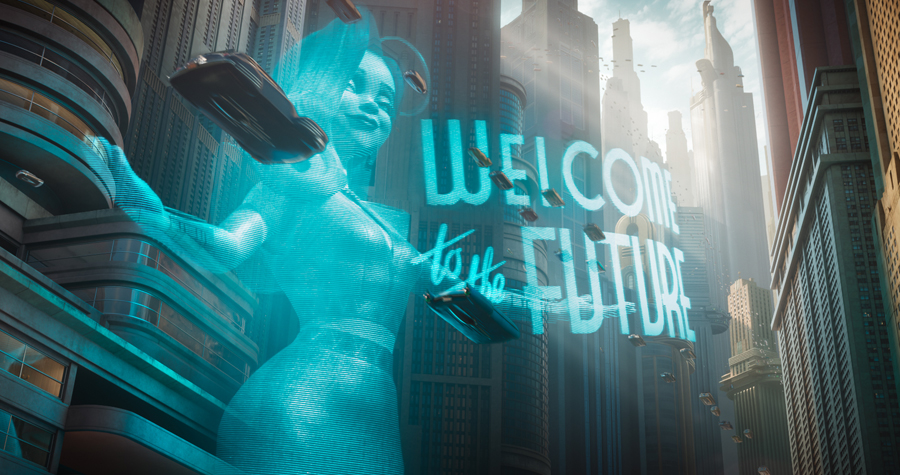
“We knew that the camera was going to be very dynamic, that the animators needed to know where the building is located so the geometry needed to exist, and it needed to have depth,” Luebbe added. “And you have daytime, nighttime, the building needs to be illuminated. We had our own custom shader for the windows.”
“And we mapped out the idea of different districts that we used for the story to help us think about the city and the relationship of one area to another,” Luebbe continued. “It made it more tangible. We’ve got an entertainment district that’s like Times Square on steroids. We’ve got quieter, more Greenwich Village areas. And there’s a maze area on the periphery, where all the recent aliens congregate. Brad always had the idea of this very intricate, interlocking, weaving that was very different from the geometry of the city.”
One noteworthy addition were context reviews of early rendered sequences where they could catch mistakes or Bird could make subtle adjustments to improve the execution with heavy prep with various departments.
The Power of Caricaturing Humans and Aliens
For the titular private eye, they studied Humphrey Bogart from The Maltese Falcon and The Big Sleep, as well as Jack Nicholson from Chinatown. Ray has movie star looks, who’s stylishly dressed and wears tinted sunglasses. But he doesn’t wear a hat. He had 10 outfits (from costume designer Neysa Bove) and needed a groom that could withstand the wind and rain. Everything was tested and iterated until the behavior was right. So, when Ray flies his jetpack, his hair goes over the wing and his outfit has a lot of physics applied to it, and that adds complexity on top of all the variations.
“He’s the lovable loser type, who just wants to do good,” said Jason Ryan, the animation director from Cinesite. “He puts his hands in his pocket like Bogart, but he’s not mannered.”
The sophisticated and elegant Venus is a cross between Lauren Bacall and Veronica Lake, and Bove made 23 outfits and 14 groom variations. In addition Venus had 10 skin variations for makeup, no makeup, dry, and blemishes. That creates a lot of presets, so they developed a tool to combine all of these that were set up during layout for both Venus and Ray.
The alien characters were obviously the most challenging as far as rigging. Eyera was difficult in terms of figuring out his tripod legs. “You could very easily just make that third leg almost go away, Ryan suggested, “but we wanted to try and make it feel like it was actually part of his being a camera.
“We also had to invent ways of rigging up legs, especially for [the towering] Vanzine Caluda, who has [six arms and six legs],” Ryan continued. “She wants to be accepted like a human, but she can’t hide all the legs under her dress, she’s got to be able to walk. So we had to figure out a rig for her, but also a way of how she was going to move.
“I actually did the cycle for her,” Ryan added. “She could turn around 360, no problem at all, without doing any sidestepping or weight shifting. But to make her walk, I had to translate her along to figure out the back legs, the side legs, and the front legs, which could walk almost like normal. Brad definitely wanted her to feel ferocious. And my group of shots was where she busts out all her limbs out of the dress and climbs over the office desk, and all six arms hitting Ray. With all the walking and posing and turning and shifting, it’s not really a technical challenge, but more of an animation challenge.”