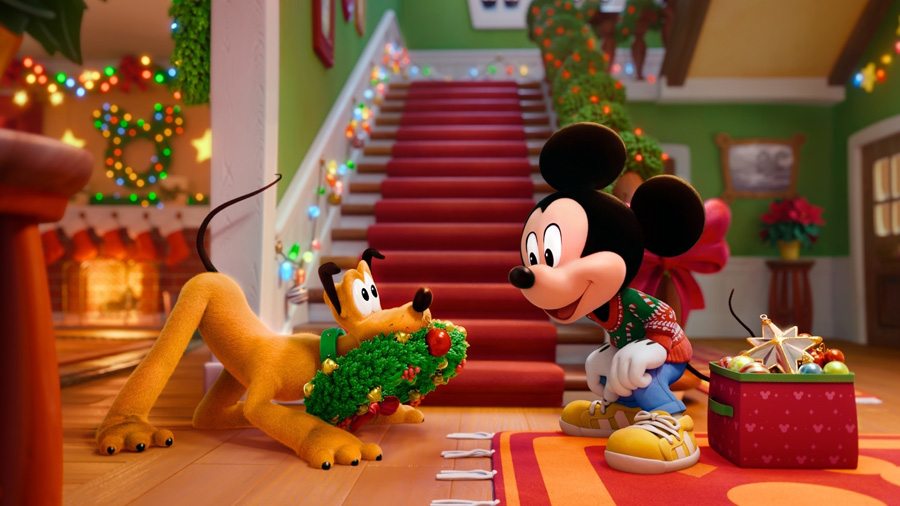
Mickey Mouse is an cartoon character co-created in 1928 by Walt Disney and Ub Iwerks.






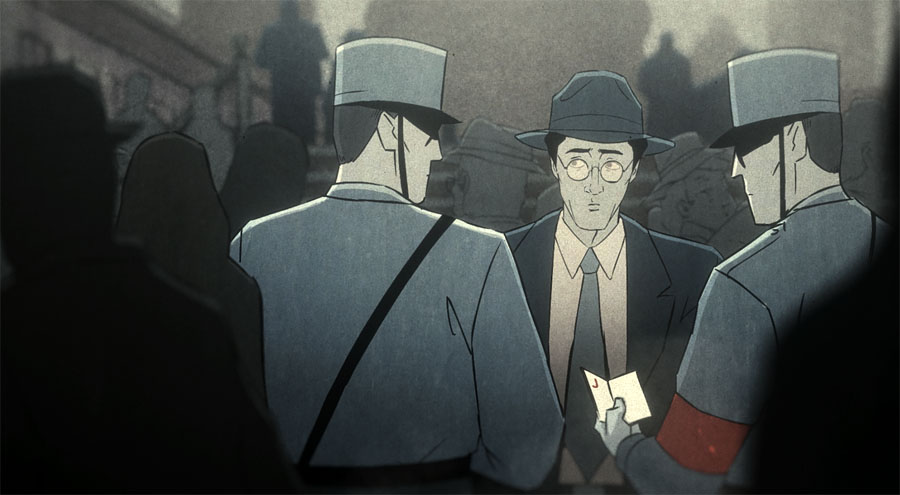
“The Whistle” is a powerful new animated short film vying for awards consideration. In Germany in 1938, it was illegal for a Jewish doctor to treat non-Jews. This short, from director Greg Franklin and producer Nancy LaPook Diamond, focuses on a doctor, who’s also a father and husband. (This Animation Scoop Q&A was edited for length and clarity.)
Jackson Murphy: Greg, this is based on a true story. How did you first learn about this and want to turn it into an animated short?
Greg Franklin: Well, Nancy Diamond and I are collaborations. Have gone back a few years. We’ve worked on some PSAs and some short projects. And Nancy really brought this project to me and my studio Six Point Harness’s attention. And she really has the great origin story about this.
Nancy Diamond: So Nancy Dickinson, our executive producer, was friends with the doctor’s son during her high school years. And when he told her the story she was so moved by it and thought it was so compelling, and wanted to make sure other people could hear the story and be moved by it and be compelled to do the right thing.
JM: Wow. That’s incredible. Nancy, as a producer of content including animation… authenticity is so powerful when it comes to what anybody wants to watch, whether it’s animation or live-action or documentaries. So how did it move you, and how did it move you instantly to say, “Okay, this is a project we need to pursue”?
ND: Well, the story is quite remarkable. And it’s only one of many, many stories like this that have taken place during those years and other years. But we did want to highlight this because this is the story that we knew. And when she first brought the story to me, the original idea would be that it would be live-action, and I actually suggested that I thought it would make a good animated short without any dialogue, which is how it ended up. We felt that that would be a more powerful way of telling the story. Not only did it give us creative freedom, but it then became universal for anybody who would watch it.
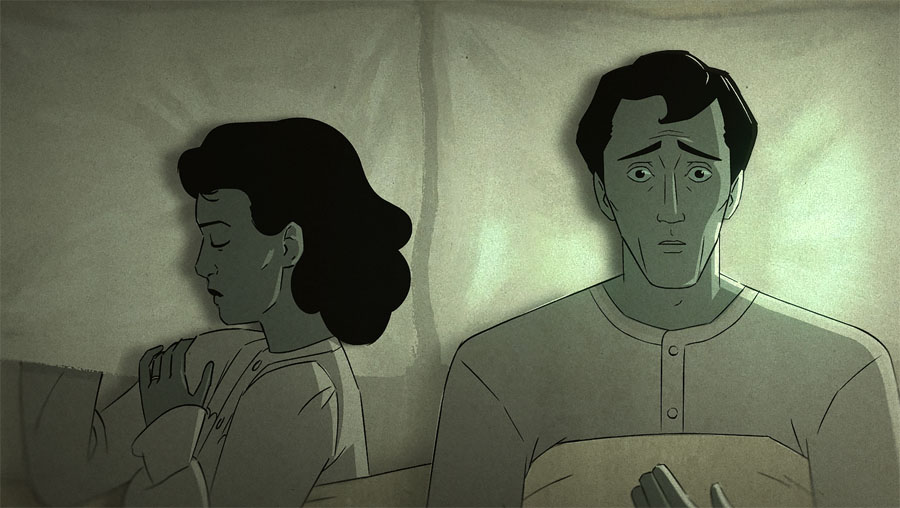
JM: Absolutely. Yes, it makes a lot of sense. And Greg, when you have a short without dialogue and you’re creating this story arc, were there challenges for you? What challenges were there in making this work as well as it does?
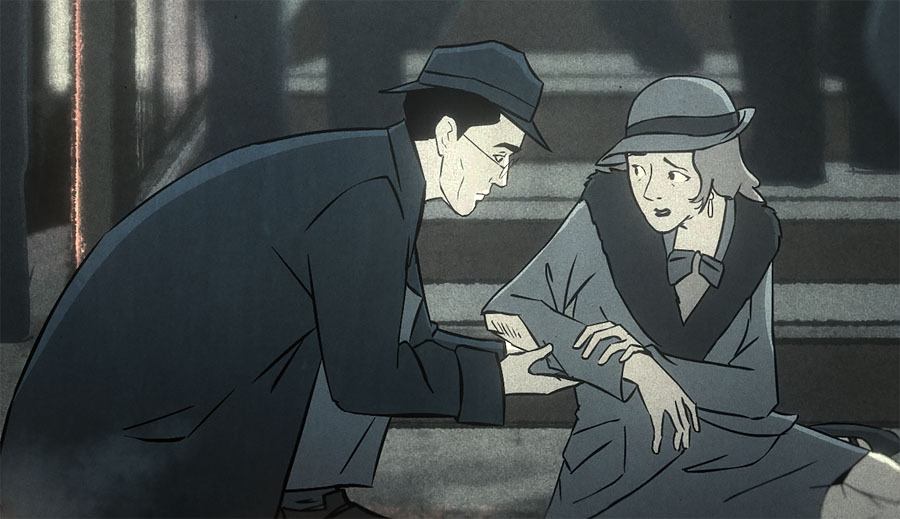
GF: I wouldn’t necessarily say it’s a challenge. It’s really its own medium. Dialogue-less animation is just one of our tools because it is such a purely visual medium that as soon as a character would start to talk, I think it would immediately take you out of the magic of that world. You definitely want to tell the story completely visually, and so there is a challenge of this being historical accuracy of there being pretty complex ideas to get across without any dialogue. For example, the whole notion of (to the story) the recent illegality of Jewish doctors treating patients is kind of a crazy concept to get across with no verbiage. That’s the one thing that we had to sort of get over. But I love the medium. I’ve been a cartoonist for many years and this is exactly the kind of project that I dream of. When Nancy brought this to us, we jumped at the chance to tell a meaningful story that ultimately has an extremely hopeful message for people. And while it was kind of a long process to complete the film, it was scary that the story kept becoming more and more relevant as time went on. But it pays to have a lot of hope.
JM: It is a meaningful film. It’s a meaningful story, and I’m so glad that you embrace animation so much, and Nancy, that you pushed for this to be in animation. What does the hand-drawn animation of this short mean to you? What do you think works so well about it — and this very distinct look that it has, and especially the color choices as well that work in the different scenes of the short?
ND: I’m a big fan of “Babylon Berlin”. The hues are very grayish, bluish, the feeling of noir. So that was one of the references we used. And we worked very hard to try to make things look like it came from that era.
GF: That is an amazing show, an amazing one. With animation, you can definitely get away with a lot more stylization in terms of color palette. We’re balancing that against historic accuracy, and when we don’t have all the data to make it extremely 100%, we lean into almost a dream-like… It’s this almost like a story that if you got too specific, it would sort of crowd out the larger truth of what we’re trying to say. We love film noir over here — love European film noir. “The Third Man” was a huge reference point to us to some of the shots, the cobblestones, the feel of history mixed in with the sort of encroaching dread of noir… just a really potent combo of influences for us to explore with this film.
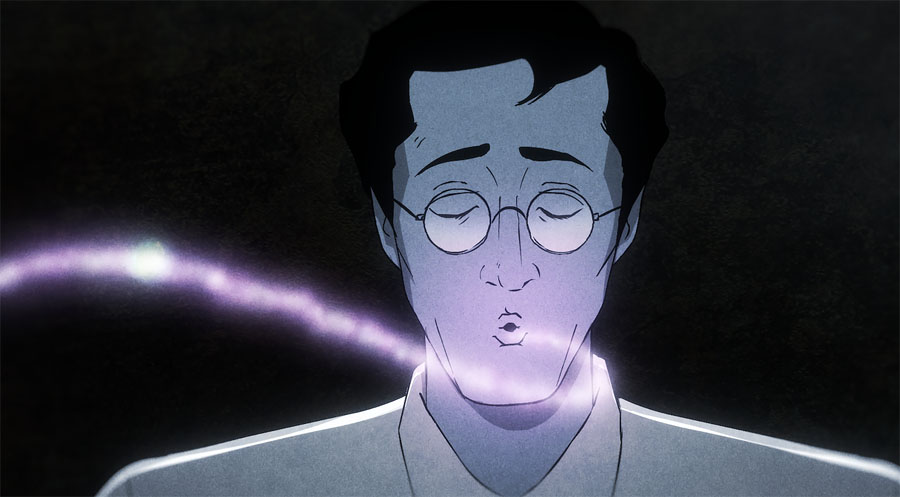
JM: And also what stands out visually is the whistle itself — the doctor’s whistle. Greg, what went into the look of the whistle?
GF: We did a lot of concept artwork to illustrate what the whistle would look like on screen. And the thing that was the overriding concept is in the darkness of the cell, the darkness of the mind, in the darkness that surrounds us at our lowest moments… What can cut through that darkness and what can shine a light out of it? What can shine a light out of the darkness? And so we experimented with some that were a little bit more literal, that looked almost like music notes against the staff that were glowing and beautiful. That was a little on the nose. We attempted a lot of different things. We did a lot of different techniques, animation techniques. We used some watercolor, sort of bleeding watercolors, and we used 3D animation to tie it to a path. And eventually, we discovered an extremely convoluted way to make it, and then we figured out what we wanted, and then we came up with a much simpler version to do all the rest of the shots. That’s basically the story of that was pulled off technically. But the overarching thing was the trail of hopeful, beautiful breadcrumbs that we would follow to get us out of this situation that we find ourselves in.
JM: It’s very effective. You do a great job with it. And Nancy, also the music in this. What stands out to you about how the music guides us over the five to six minutes of this short?
ND: Exactly. It does guide us. And we spent a lot of time, we had a lot of hit-and-misses trying to get the right music. We worked with a wonderful composer in Austria [Frank Herrlinger], and he just was magnificent. That’s the only voice of the film since there’s no dialogue. So it had to be strong. It had to be the right sound. We’re very happy with it. But it took us a long time to get it right.
JM: It is excellent and moving. I have to ask you about Josh Gad being involved in this as an executive producer. Two-time Annie winner for his voice work in the “Frozen” films. One of the biggest influences in animation, especially voice acting today when you look at “Frozen” and “Angry Birds” and “Central Park” and all that he’s done. How did he come on board? What attracted him to this project, and how is it having him be a part of “The Whistle”?
ND: I had the opportunity to show him the short. And as the grandson of Holocaust survivors, he was very moved by it, and it resonated with him, and it’s just been a pleasure to have him on our team.
JM: Wow. I’m glad he is a part of it. He’s a great guy. I’ve met him on a few occasions over the years, and he’s so talented. Great to have him championing animation like he does. This short has been honored by the Los Angeles Animation Festival and other groups. You’ve had these honors which are so well-deserved. What has that meant to you, and what would more consideration throughout this awards season mean to you for “The Whistle?”
GF: The awards are fantastic. Obviously, the recognition is amazing. To me, the real joy is getting to experience it with people in an audience, in a screening. As an animation artist, we don’t often have the opportunity to share with audiences in a collective space. So much is watched on computers and on TVs in separated areas. And sometimes you’ll get to see something with your friend, and you’re kind of watching them watch your movie, and it’s very awkward. But this has been really amazing, the response that we’ve gotten from festival audiences. The festival run has just been spectacular. It’s just really, really moving to see people come up and see how the thing that we put so much of our hearts into has touched people in a way that is unusual. It’s extremely gratifying to be able to share this film.
ND: I echo everything that Greg has said. Plus, it’s just been so thrilling to see how the message of hope, empathy, kindness, the ability of each one of us to do the right thing has resonated with audiences and people who have had the opportunity to see the film outside of the festival run. We’re just absolutely thrilled, and it gives us hope. It gives us hope, and we continue to hope that things will get better in the world.