Mickey Mouse is an cartoon character co-created in 1928 by Walt Disney and Ub Iwerks.











Wildwood, Laika’s sixth stop-motion animated movie (opening Oct. 23 from Fathom), but first set in its hometown of Portland, offers its boldest, darkest, and most ambitious fantasy adventure. Animation Scoop recently visited the studio for an exclusive, behind-the-scenes set visit with some of its department heads, along with a sneak peek at 20 minutes of footage.
Based on the popular YA novel by Colin Meloy (of the Decemberists) and illustrator Carson Ellis, Wildwood follows 13-year-old Prue (Peyton Elizabeth Lee) and classmate Curtis (Jacob Tremblay) on a daring mission to rescue her infant brother Mac from a flock of crows into Portland’s forbidden forest, where a fantastical world exists.
The footage was a stunning display of nuanced performance and immersive spectacle, wrapped around heightened naturalism (with the help of legendary cinematographer Caleb Deschanel). In one sequence, Prue escorts her brother through Portland’s iconic St. Johns neighborhood before his abduction in a playground; in another, she soars on the giant golden eagle, the General (Angela Bassett), the movie’s most innovative puppet; and, in another, Prue escapes from a mansion pursued by humans and animals wearing an array of period clothing.
This was unprecedented in scope and scale for stop-motion.It blends the hand-crafted, tactile quality of stop-motion with CG polish and embellishment. The result expands the format into a more epic and emotional cinematic experience.
Wildwood has been a 16-year passion project for Laika CEO and director Travis Knight (Kubo and the Two Strings), who responded to its theme of grief and love and folkloric mythology. However, it took seven years to make this love letter to Portland in all its quirkiness and beauty, as Knight (who was unable to participate in the set visit) waited for tech to catch up to need.
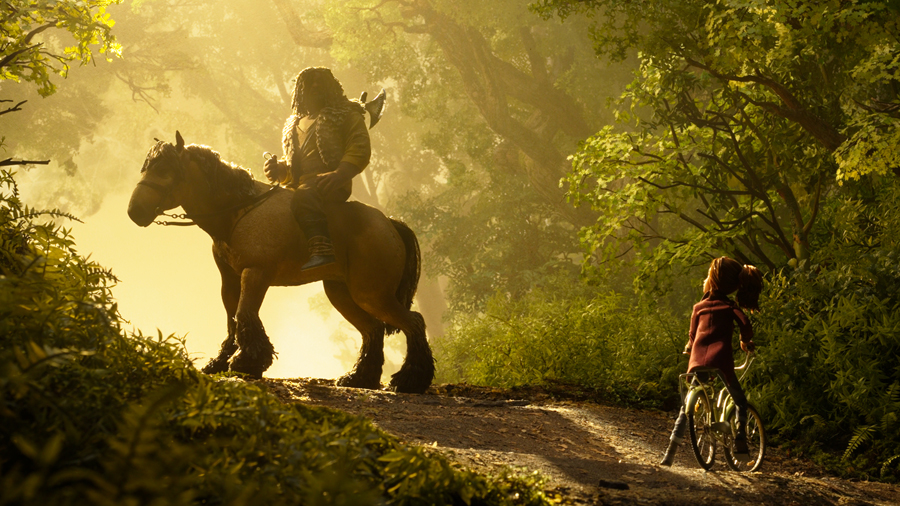
Puppeteering the Greatest Cast of Human and Animal Characters
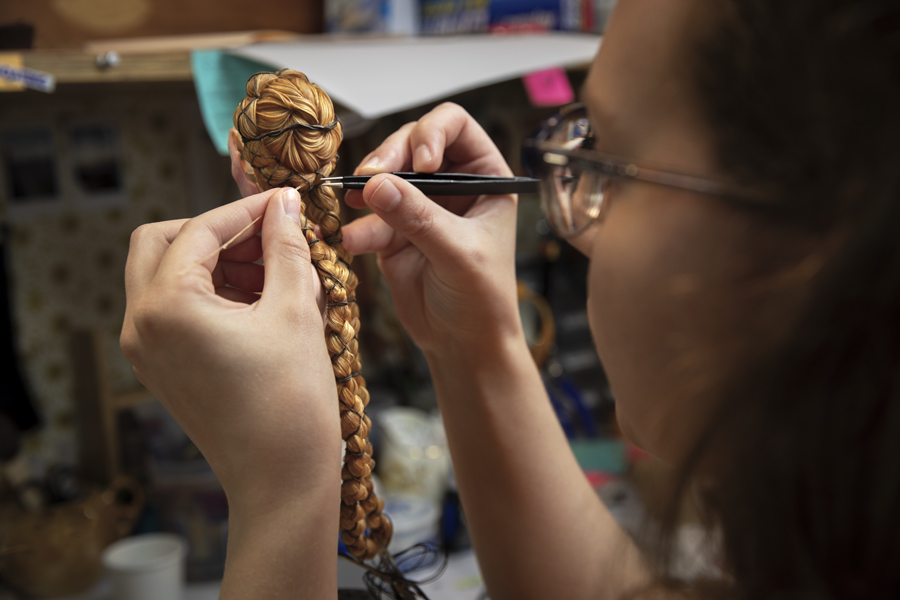
Laika’s industry-leading puppetry (including its Academy Award-winning rapid prototype 3D printing with resin) needed to achieve a new level of nuanced performance to express the movements and emotions required of its characters. There were 233 handcrafted puppets, with 83 unique fabricated puppet builds and 75 unique hand designs for principal puppets. In addition, 125,000 armature components were precision machined. On top of that, a record 142,030 replacement faces were created (including a record 1,124 individual replacements for one shot). Plus, it had the widest variety of hairstyles and natural hair textures ever created for a Laika production, including braids, ponytails, Afro hairstyles, curls, waves, and straight.
In terms of complexity, Prue’s facial performance boasted 12 progressive distress textures, with seven increasingly damaged variations used throughout the final battle. Curtis received eight facial texture variations, and a record 67 shots containing visible tears.
“From a performance point of view, it’s all naturalistic,” said Brad Schiff, animation supervisor. “But now there’s this whole next generation who’ve been inspired by the work that we’ve done, who are coming straight out of school with this incredible, natural talent to do this precision work. It’s like being able to draw photorealistic through puppets. And given that, with the new technologies in materials, in silicones, being able to make puppets that you can tension really lightly, so you can get the most finite of movements out of them, to get the most natural, the most subtle performances that you can.
For instance, there’s a shot of Prue sitting in a room, rubbing her hands, which was done at actual scale. “Normally, we would have made 200 percent hands to do that,” Schiff continued. “But they held up, and the animator was able to sit in a tight room. And the camera’s close to the hands, too. We never would have been able to do anything like that before.”
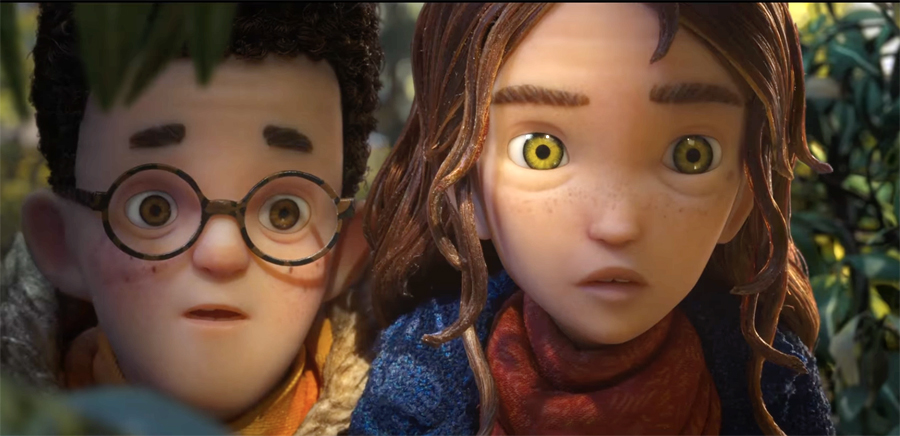
They also played around with new materials. To improve breathing, they fully implemented something from Missing Linkcalled breathers. These were chest plates that were able to move the diaphram by turning a key in the back of the characters.
A more significant innovation, though, was the introduction of muscles for the first time after some early experimentation with voxels to emulate the human body. “And once you have this built, you could actually 3D print it inside this entire body,” explained Brian McLean, the Rapid Prototype director. “And this becomes very inexpensive and quick to produce a fully assembled part. Travis saw this asked if we could make muscles for our puppets.”
This led to three characters getting animatable biceps during fight scenes. “These bicep movers are made out of a material called horse boning, which is used in hat making, and it comes in big swaths of tubes and it’s basically a mesh,” added McLean. “When you push it in and out, it expands in the opposite direction.”
But the biggest challenge was creating anthropomorphic animals walking around and wearing clothes in the fantasy world. This was a vast animal kingdom comprised of coyotes, crows, an owl, and the giant golden eagle, each requiring its own physical language, movement, and anatomy. For example, the coyotes used 12 bespoke battle-damage textures and 29 interchangeable damage elements, creating hundreds of possible combinations. And fur needed to look convincing and be stable.
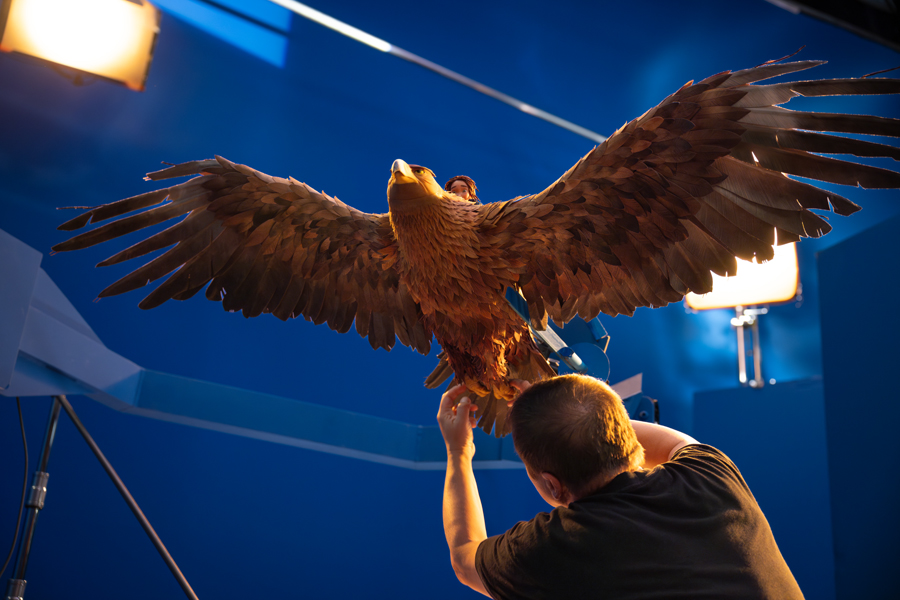
However, the General is the masterpiece. This marks the first Laika movie to feature a bird whose wings fully open and collapse realistically. The studio built three separate versions of the General to accomplish a different style of flight. Each General was 34 inches with a 64-inch wingspan. It carried 3,794 individually dressed feathers, with roughly 16,500 feathers fabricated throughout production, including replacements.
The first puppet contained motorized shoulders that could be programmed to repeat precise wing movements. The second version incorporated mechanical gearing within the shoulders, allowing animators to adjust the elevation and projection of each wing while maintaining complete control over thesilhouette. This became the primary puppet for the thrilling ride with Prue.
For dynamic aerial sequences, the puppet was mounted on a six-axis motion platform that allowed animators to combine body movement with individually controlled wing performance. For the most acrobatic maneuvers, the team employed a 10-foot-wide gimbal (controlled by the Octowiddler 2000).
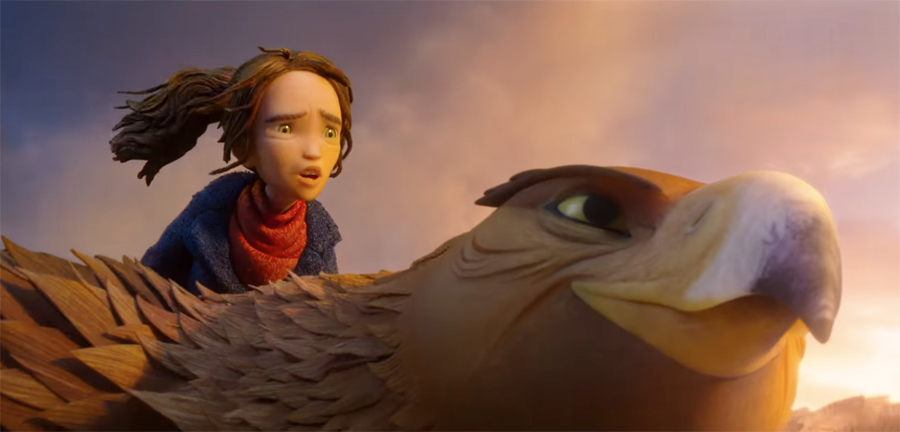
“One of the biggest challenges is that they’re kind of shapeshifters,” Schiff said. “And you have to get them from tucked in and squat to spread out and flying. And just the mechanics and the materials that you have in there, it’s almost impossible. It was quite a challenge to get one that could do all of those things. So we had the folding one, and we had the two flying ones. All of the feathers are wired, are foiled, so you can get movement to feel the wind resistance as she’s flying through the air.
“And so she had to move as naturally as possible,” Schiff continued, “and there’s a silicone skin that the feathers are all attached to, so when the mechanics move, it can stretch and all the feathers move with it. And she had breathers as well. But she’s also a vehicle for Prue, who’s in awe on the back of her. She had to move beautifully and naturally as well. And there’s no simulation for hair and cloth in stop motion, so her hair is all wired to be able to move in the wind, including her twisting ponytail. But we had to make certain adjustments because, in real life, her hair would be going all over the place, and we didn’t want it to be distracting. We wanted to feel like she was flying through the air, so we made a conscious decision to slow it down to make it feel a little bit more beautiful and flowy.”
Costuming Two Distinct Worlds
Deb Cooper, the costume designer, had two worlds to work with: contemporary Portland and an ancient fantasy forest. Inspired by Ellis’ folksy and mystical illustrations, Cooper utilized line work, textures, and silhouettes, along with a watercolor look.
“I research and ideate costume designs that provide an infrastructure to anchor our characters and their identities and personalities, and to visualise their emotional arc with costume changes that propel our story pivots,” Cooper explained. “I look for specific items, fabric textures, pattern cutting information, and costume treatments that enable these to be built in this scale, and in a three-dimensional build from a 2D design. I work with the director and I share reference images and we just keep going back and forth editing those until we decipher what our characters are going to be wearing and why they’re wearing it.”
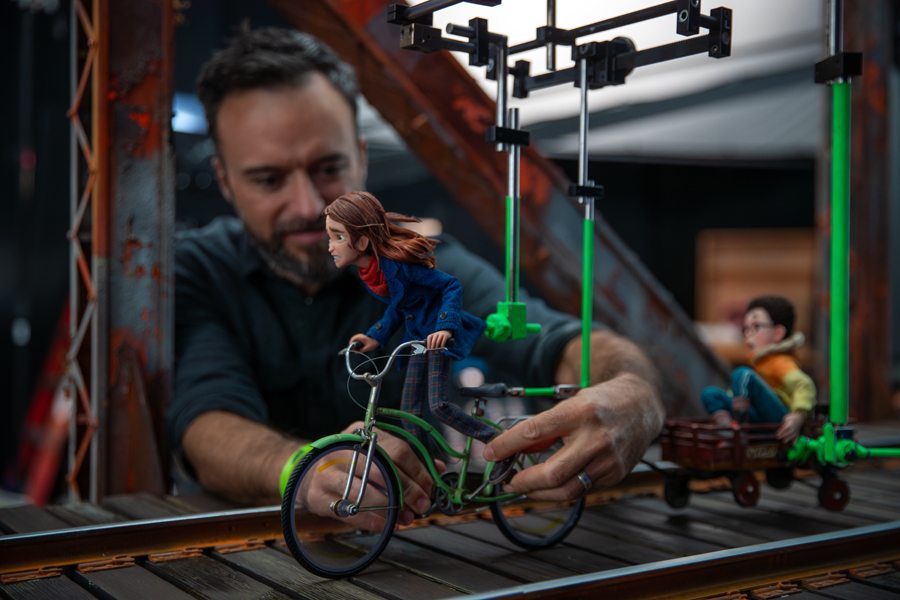
For Prue’s striking blue peacoat, Cooper chose an ovesized garment that Prue might’ve picked up at a secondhand store. “She’s pretty sassy and she thinks she knows everything,” Cooper added. “This is her coat that she picks when she goes back to quickly change clothes to head out on this adventure. She doesn’t know where it’s going to take her, but she’s got on clothing that she’s worn for a while [patch jeans, a jacket with rolled up sleeves, boots] so she knows they serve her well.”
Curtis, who joins Prue on the adventure because he has a crush on her, wears a schlumpy parka, tracksuit pants and special Converse high tops that will be sold as merch. “And so Prue’s silhouette is very strong and Curtis is on a more bumpy ride,” Cooper suggested. “He changes costume into quite dramatic versions and goes through a few more changes in identity.
Then there’s Alexandra (Carey Mulligan), the exiled Dowager Governess, who has organized the militarized coyote faction. She’s battle ready and fosters a very ancient-looking armour. “She has these elements which come from found things among the forest,” continued Cooper. “So do the bandits. They have very neutral clothes. What they’re wearing have been made from things they found in the forest: flax and bark.”
Even the talking animals wear ancient clothing. “So the idea is these characters have just picked up these costumes or things from different eras (Victorian, medieval, early 20th century),” Cooper said. “They’ve just landed in the forest somewhere and are wearing them. They have a look of their own, but they’re also really unusually put together.”
World Building a Love Letter to Portland
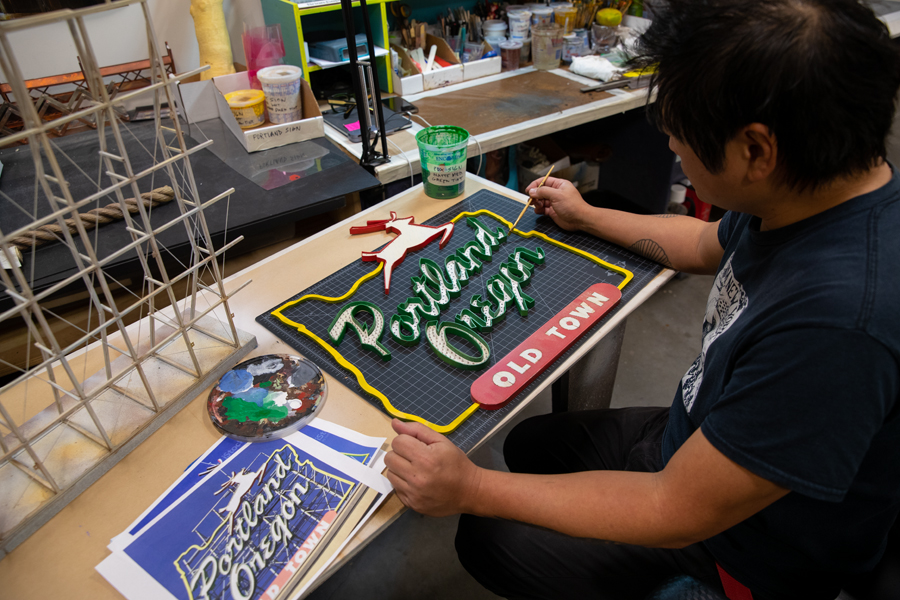
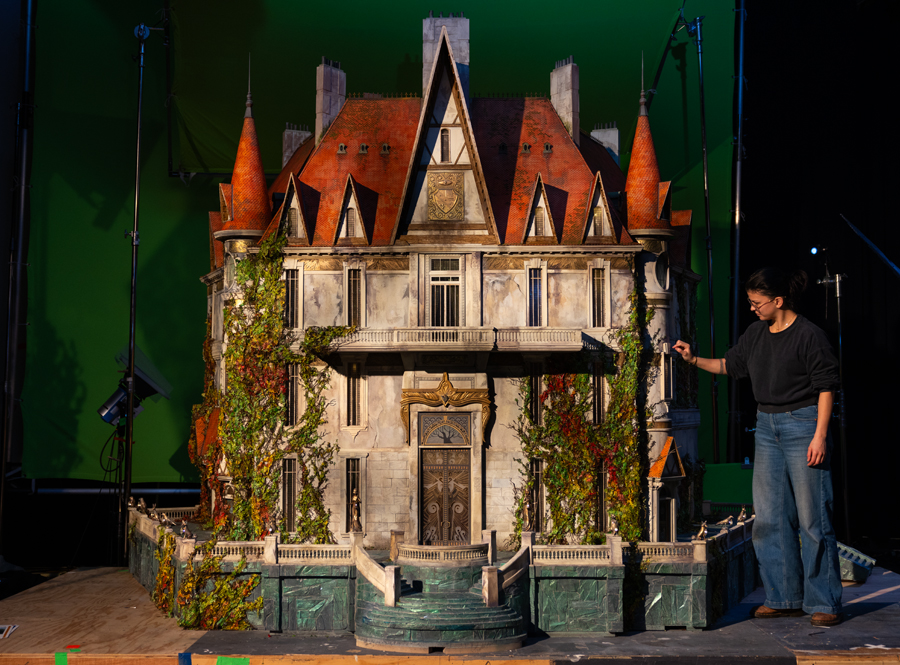
Portland native Nelson Lowry, the production designer, had a personal stake in Wildwood. He spent years scouing the region and compiling lots of photo reference of nature and architecture (highlighted by the legendary Pittock Mansion). During the set visit, Lowry showed off the St. Johns farmer’s market (with plenty of Laika Easter Eggs), the woods, the fairy tale forest realm (including Alexandra’s shabby chic underground quarters), and the massive battlefield. It was a riot of color.
“Nature is notoriously hard to do in stop-motion,” Lowry said. “In my experience, in my first couple of forests, I thought it looked great until you put a camera on it and you didn’t know what you were looking at. But we sort of found good ways to see how nature organizes itself.
“You can’t really go out and buy stuff,” he continued. “It doesn’t quite work. But there is dead moss that we can use, but the trees are originally cardboard and cast, and the leaves are all tissue paper and fabric, and they’re supported by very old school chicken wire, spray painted in black. I love that mix of high-tech and then for dirt and a lot of materials, we use ground-up walnet shells that comes in all different grades for other industries. It’s cheap as chips, so we buy large volumes of it.”
Lowry credited cinematographer Deschanel for creatively figuring out the lighting on his first stop-motion production. “One of his tricks was he took some of our assets and brought them up to Forest Park and put them in different lighting conditions and did a lot of photo reference. And so we could put them side-by-side in the theater and see how the lighting needed to change.
“I personally think that this film has the best outdoor lighting of any stop-motion film that I’ve worked on,” Lowry added. “It’s really tricky because if we were to put the key light where the sun really is, it would be where the moon is, approximately. So Caleb found this very clever way to emulate that without having the shadow spread too much.”
Lowry showed off one section of the battlefield (part of four different sets with 3,000 combatants). “It’s a spectacular sequence,” he suggested. “You read that in the script and you’re like, ‘Yeah, right.’ But those trees that are in those digital extensions are our trees that we built and scanned. To me, it feels like a giant stop-motion step, and that was very intentional.”
However, the animators had to maneuver very carefully around the set, wearing socks or padded shoes. “It’s built for strength,” Lowry said. “It can’t move during shooting, so it’s all steel. This probably has 30 tables under it. It seems kind of destructive, but we’re able to break a piece out of here on a clean line, and then get the animators close to the puppets. And then we just put it back together. Because we do them in multiple passes, there would be three or four puppets in a shot. Then we burn a blue card, do the next layer, and then VFX is able to scan the characters and do the digi-doubles, so, of course, we did not animate 3,000 characters fighting.”
But without recent advances in material tech, Wildwood would not have been possible. “Whether it be paint that doesn’t fade or a new kind of soft material that we can mold in very specific ways, I was able to do a lot that’s more realistic, but it’s still stylized,” Lowry explained. “Even printing props is really good because you have to scale them for a close-up and just print them larger instead of having to sculpt a new prop at a new size. So these are time-saving things that allow us to put more into the movie, and making the world feel absolutely cohesive and consistent throughout every environment. And the cool thing is, it doesn’t take anybody’s job away.”