Mickey Mouse is an cartoon character co-created in 1928 by Walt Disney and Ub Iwerks.










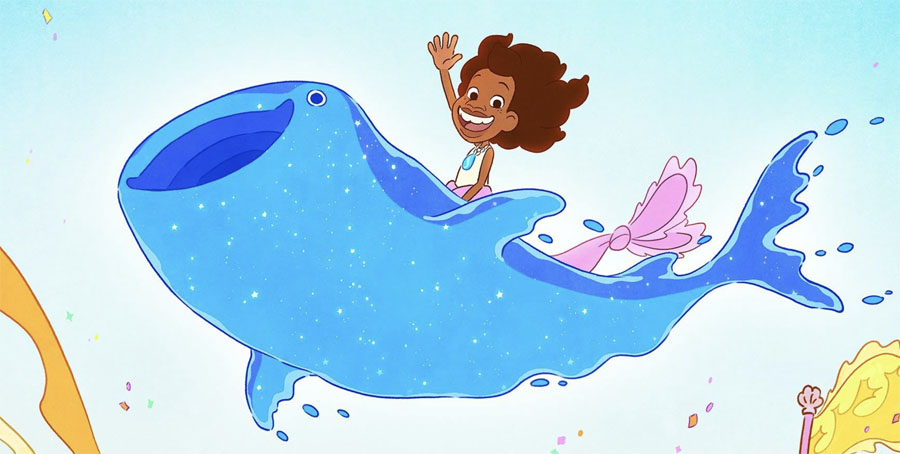
Louise Bagnall earned an Oscar nomination for her 2018 animated short Late Afternoon. She makes her feature directorial debut with Julián, which is vying for awards consideration. It’s the seventh feature from Cartoon Saloon, the studio behind Wolfwalkers, The Breadwinner and The Secret of Kells. Julián, based on a children’s book, is about a young boy and his grandmother strengthening their relationship during a memorable summer. (This Animation Scoop Q&A with Bagnall was edited for length and clarity.)
Jackson Murphy: After you directed “Late Afternoon” [and] got the Academy Award nomination, did you immediately have the goal in mind of, “I wanna direct a feature film now”? And what excited you about directing a feature?
Louise Bagnall: So I think for sure after “Late Afternoon” and the great success we had with that film, it felt like maybe it was time to try and take on something bigger. And that’s when I came across the book Julián Is A Mermaid, which is what this film is based on. And as soon as I saw the book, I just thought, “Wow, this is an incredible book. It’s incredibly beautiful, but also it has this amazing story at the center that seems simple on the surface but actually has this depth.” And I felt like if we could explore that more fully in a film, get in to see those characters, understand them more fully, and really dig into those themes, I thought it could make a fantastic film. So that’s really what, spurred me on. It really grabbed me.
JM: What was most fascinating about the experience for you of taking a picture book at [that] length and expanding it out to an 80 / 85-minute feature film and adding even more layers to the story here?
LB: Actually it was one of the things that was so exciting about it because I felt like the bones of the story were so good in the book, but obviously very slender amount of words, very slender amount of images. So it really gave us room to expand and dig into the characters. And so we got to think about, “Okay, well, who is Abuela? Where does she come from? What’s her story? And what journey does Julián really go on? What else is he learning [during] his time when he stays with his grandmother? What else can he take in?” And also, what would the whole world look like from his point of view? Not just this little slice that we see in the book, but actually what does the block look like that they live on? What’s the other people on the block like? What are the kids like? So it really gave us room to expand. And of course being able to bring something like the mermaid parade to life on screen with music, which was so important, with sound and with movement and everything. It just really allowed us to celebrate the ideas that we had to work with to begin with there.
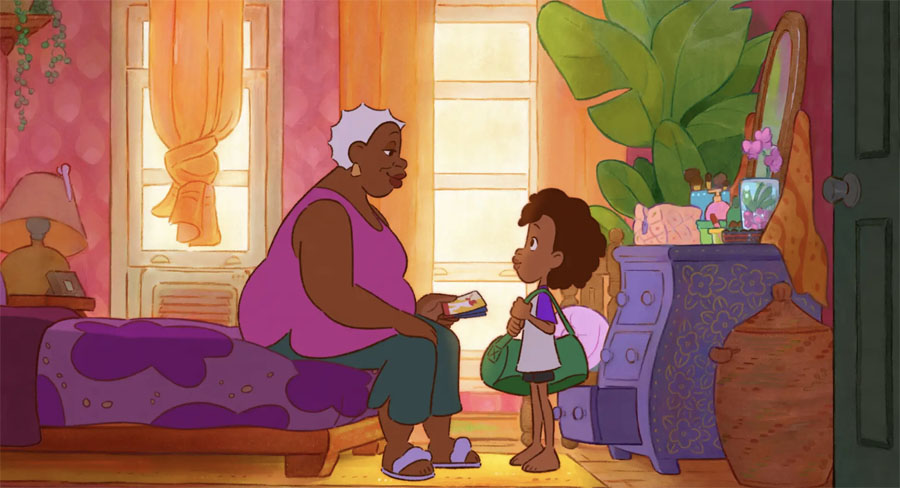
JM: Absolutely. Julián is a young boy. He’s visiting his grandmother in Brooklyn in the summertime, and the dynamic that they have… there’s a lot as the film goes on. What was most important to you about showing that dynamic between Julián and his grandmother — and what that relationship means to the core of what this film is all about?
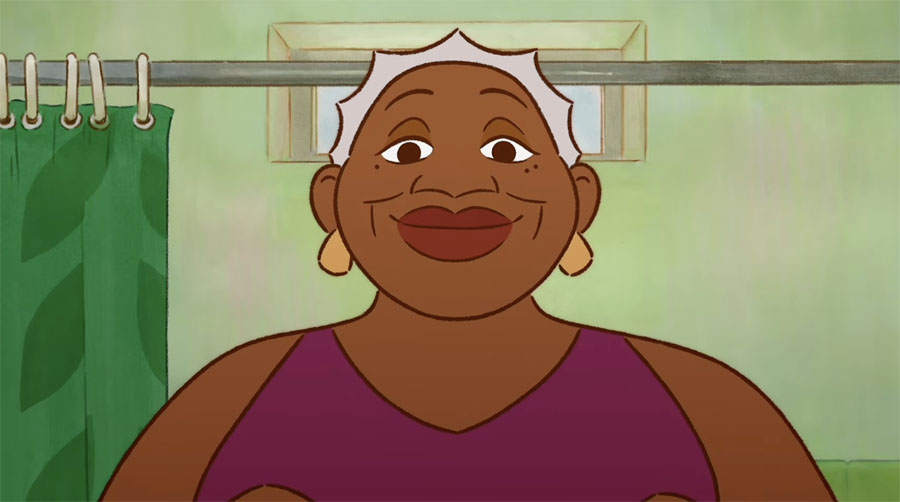
LB: The relationship is really at the center of how we tell the story. So we get to meet Abuela at the beginning of the film, kind of alongside Julián, and basically the journey of their relationship developing is kind of how we tell the story of Julián’s own journey. Being able to sort of track that relationship, see how it grows — and it was really important to find the balance that Abuela was somebody who was very warm and welcoming, loved Julian, but also didn’t fully understand him. Maybe doesn’t know how to talk to him or doesn’t understand when he asks her things what he really wants. So I think it’s about also this kind of very believable relationship dynamic that evolves between them, and how they can overcome those challenges that they face within that relationship. And I think it’s something that a lot of people will relate to. But it’s also something that I think needed to have a lot of warmth and a lot of believability at the core.
JM: Yeah, warmth is a good word to describe the relationship, especially more as we see [as] the film goes on. Julián has such enthusiasm and spirit for his love of mermaids, and we see that over the course of the story. What was most important and pivotal to you about presenting this over the course of the film, and for people of all ages to experience Julián showing his true self and his true interests in the fascination with mermaids?
LB: The mermaids in the story really form a way of being able to sum up what Julián is really striving for. He’s a kid, so he’s not gonna be able to explain with a lot of nuanced detail about exactly what he wants or why he wants it. He doesn’t understand that yet. But what he can do is he can express himself in his own truth, his own emotional truth. And what I wanted to do in the film was to really bring the audience along with that journey of not just kinda discovering how mermaids could be and his idea of what a mermaid could be, but also bringing us along on the journey so we felt the desire alongside him. We want him to succeed. We want him to see him fulfill that potential. So it was very important building in with his creativity, how he kind of navigates all of these ideas he has, and just make it something that the audience would root for as well. It’s not just a cute idea. It’s got a sort of surface which is fun. “I get to be a mermaid and swim in the ocean and be colorful.” But there’s obviously deeper connections in there, not just for how he expresses himself, but his own culture, his own roots, everything like that kind of come in, all into that idea of being a mermaid.
JM: I think creativity is a powerful word when describing this movie. And as an artist, as an animation director, I’m sure creativity is what it’s all about for you when it comes to making something like this. When you think about that word and the journey you went on with this film, what stands out to you?
LB: Sometimes I laugh ’cause sometimes I feel like… we were in Julián’s position sometimes, you know? We’re trying to tell this creative… we’re coming up with these creative ideas, but sometimes we don’t know if they’re gonna work or we’re getting notes back and they don’t understand us. So we always went through this kind of creative process ourselves, and we often do as artists,. We go through this trial and error. We learn, we make mistakes, we find our way through. Some stuff fall apart, and other times you have to rebuild it. So I feel like we ourselves were going on the same kind of creative journey a lot of the times as Julián is going on. But also, it’s part of why we do what we do. We love this part of the process, and I really wanted to embrace that at this film. So it’s one of the reasons why we really went in, full on, with the way we created the world in “Julian”. We created those backgrounds using coloring pencils and markers on paper. So all, I think, 747 backgrounds in all.
JM: Wow!
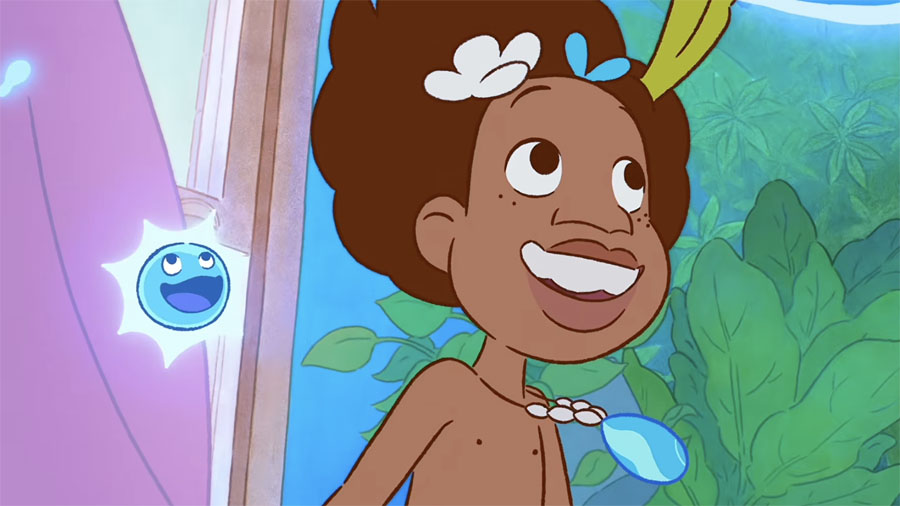
LB: All on paper, so it just allowed the artist’s hand… It’s not just purely for the ethos of making nice creative choices. It’s also to allow that kind of artist hand, those human imperfections to come in, and feel that warmth coming and the love of the artist coming through the screen for the audience. It’s part of how we craft what we’re making and how we pour our energy and care into what we’re making.
JM: The animation is so bright, it’s so colorful. And also, you create this atmosphere of Brooklyn and the neighborhood, both visually and with the characters, with the store owner we meet and some other characters, that is really friendly and has an authentic feel and flavor to it. What was most interesting for you… did you do specific research… how you captured that flavor so well?
LB: Yeah, we did quite a bit of research in terms of the visual… what would you see in Brooklyn? But actually what was so important was talking with people who are living there or have lived there. A very important part of the creative process was our writer, Juliany Taveras, who came on board to do the script, and really was able to bring in all of those nuances about living on a block like Abuela does in Brooklyn. But also, those aspects… What really sing about living there? Well, it’s actually the community. It’s a beautiful place in a lot of ways, but it’s the community that give it that heart at the center. So it was very important to bring that into the characters that live there and make them feel like they were part of the world. It is a fantastic place to set a film. And of course, I was inspired by people like Spike Lee and “Do the Right Thing”, and all those wonderful films that are set in Brooklyn. But we also wanted to give it our own flavor for “Julián”. It’s his point of view, so let’s find his way of looking at the world.
JM: Absolutely. Friendship and community really come through. The new friends that Julián meets — those girls — have a lot of confidence and give him more confidence. And I think you also need confidence when it comes to making an animated feature film. So when you think about that word, confidence, and the character arcs there, what comes to mind?
LB: I think for me confidence comes when I know the material very well. It also comes from understanding my own desire behind what’s driving me to make this project because that’s something I can return to. It doesn’t sort of fade away. You’re in this for quite a long time, and people ask a lot of questions of you over that process. There’s a lot of choices you have to make. So having confidence in what you’re choosing really comes down to, “Well, what is this film all about, and… how do I want it to speak to an audience, and what [am] I really trying to accomplish with this film?” And if I can understand that, even just inherently, even if I can’t put exact words to it, if I understand that myself, then I know I’ll have the confidence to be able to speak and make those choices, and help my team to get on the same page, and motivate everybody to basically aim for the same goal.
JM: There you go. Academy Award winner Zoe Saldaña and her sisters are executive producers on “Julián”. How did they become involved in this, and how does it feel having Zoe and her sisters be a part of the “Julián” team?
LB: It’s so amazing having their support. They are from New Jersey via Dominican Republic as well. So actually having them come on board the project was a real vote of confidence in terms of what we were doing with the film. But also, it really spoke to them in terms of the type of themes and the way we were handling those themes. So for me, it was a really wonderful addition to have that kind of support coming in. Obviously, Zoe and her sisters are such a powerhouse of the industry that that’s great in itself. But also honestly just the vote of confidence in terms of coming from their own background, how they felt like it connected to something that felt real for them and believable, and that was really powerful, actually.
JM: That’s fantastic. And Zoe’s performance that she won for [in] “Emilia Pérez”, a couple years ago, was outstanding. This is the seventh feature film from Cartoon Saloon, a studio that has given us “Wolfwalkers” and “The Breadwinner”… and the “Puffin Rock” film was delightful a couple years ago. What do you hope that “Julián” says about where Cartoon Saloon is at in 2026 — and how you wanna convey that to the Cartoon Saloon fans who are gonna watch this?
LB: “Julian” might look a little different in some respects to what people are familiar with. But actually, if you look at our full repertoire of films, we’ve always explored themes and ideas that are really about… I think Nora [Twomey] said recently… maybe we have to be a little bit brave to tell the stories we’re telling. We’re not always looking for the easiest story to tell. We’re looking for the story that means the most to us. We’re looking for those kind of stories. So I think in that respect, that’s always what we’ll look for, and that’s… what “Julián” is about. That’s what the previous films — “Song of the Sea”, “Wolfwalkers”, “The Breadwinner” — all of those films come back to some essential core in that respect. And I think visually, we’re always looking to make a film just as beautiful as we can, use our 2D animation, and really see what we can do with the medium. We never wanna be boxed in by what we’ve done previously. We’re always looking for new ideas and ways of exploring it. But also, we’re looking for ways of telling stories that are suited to that story. For “Julián”, we wanted those coloring pencils and markers because that’s probably what he would have in his pencil case. Whereas for something like “Wolfwalkers”, it made sense to reference wood block printing and that kind of stuff, because that’s kinda coming from the time that the film was set. So we really are trying to make work that excels in our own medium, and that really speaks about the themes and the story that we’re trying to tell.